
Supercompensation at a glance: phases and how long they last
Supercompensation is a model in which performance after training goes through four phases: fatigue; recovery to the starting level; supercompensation, a short period above the starting level; and loss of that surplus when no new stimulus follows. It was described by the Soviet scientist Nikolai Yakovlev and remains one of the foundations of training theory (Methenitis 2018) and of periodization.
Each system recovers at its own pace, which is why there is no single answer to "how long does supercompensation take".
| What recovers | How long it takes | Source |
|---|---|---|
| Leg strength after a heavy session, e.g. Barbell Squat 10 × 5 at 80% 1RM | 33-72 h | Raastad and Hallén 2000, Thomas et al. 2018 |
| Strength after sets to failure: Barbell Bench Press and full squat, 3 × 10 | slower recovery for 24-48 h than after the same work short of failure | Morán-Navarro et al. 2017 |
| Isometric leg strength after 8 × 10 | still lower after 72 h; after 8 × 3, back to normal by then | Bartolomei et al. 2017 |
| Protein synthesis in an arm muscle | more than twice as high after 24 h, almost back to normal after 36 h | MacDougall et al. 1995 |
| A powerlifter's peak before a meet | 1-2 weeks with 30-70% fewer sets and reps, weights usually from 85% 1RM, then 2-7 days off | Travis et al. 2020 |
Glycogen supercompensation
Glycogen supercompensation has been measured directly: after exercise and a few days of a high-carbohydrate diet, the glycogen store rises above normal, but only in the muscles that did the work (Hingst et al. 2018). Carb loading before a marathon is built on this (Katz 2022); for strength training you don't need it.
The fitness-fatigue model: why supercompensation is a simplification
The fitness-fatigue model assumes that every session has two effects at once: a small, long-lasting gain in fitness and a large, quickly fading fatigue, and what you lift in the gym is the difference between the two (Imbach et al. 2022).
Supercompensation draws one curve that drops and rebounds after every session; this model draws two at the same time. That's why in a hard mesocycle, especially for advanced lifters, performance can stall while fitness rises: the gain is masked by fatigue that only clears in a lighter week (Bettariga et al. 2025).
- Fitness
- Fatigue
- Readiness
Over 7 weeks of rising load, readiness dips slightly because fatigue grows faster than fitness, and in the lighter week 8 it rises above the start, as after a deliberately hard block before a meet. The model shows a similar jump after any lighter week, though, even without a prior rise in load, and in a study with a week off in the middle of a program, strength rose more slowly than without the break (Coleman et al. 2024). In a regular block, a lighter week protects you from fatigue but doesn't hand you a PR (deload).
This model simplifies too: its parameters differ between people and depend on how you count load, so it won't predict the day of your PR (Vermeire et al. 2022).
What supercompensation means for your training
Supercompensation explains well why you need rest and a lighter week, but it doesn't set the day of your next session. Train the same muscle hard again usually after 48-72 h (training frequency).
You often read that if you miss the "supercompensation window", the training effect is lost. Yet 2 weeks without training did not lower strength in trained men (Hwang et al. 2017).
| Situation | What to do |
|---|---|
| Heavy barbell squat or deadlift, 3 or more sets at RIR 0-2 | next hard session for that muscle usually after 72 h; after 48 h only lighter: fewer sets, RIR 3-4 or a machine exercise |
| Machines, cables and isolation, sets at RIR 1-3 | the same muscle again after 48 h |
| 2-4 sets far from failure (RIR 3 or more) | the same muscle even on back-to-back days |
| Weaker in most exercises at the next session | don't add weight; a second such session in a row is a signal to deload |
| A 1RM test or a meet in 1-2 weeks | a taper instead of a regular week (block periodization) |
The day after the barbell bench press, bar speed was slower than before training after sets to failure and with 1 rep in reserve, while after sets with 3 reps in reserve it did not slow down; after 48 h the differences shrank (Refalo et al. 2023). For the next day, RIR 1 is almost as tiring as failure. Judge "weaker" by estimated 1RM from the 1RM calculator at the same reserve: then 100 kg × 6 and 95 kg × 8 are almost the same result.
Beginners vs advanced lifters
When you start training or switch to a new exercise, soreness and lower strength can last several days, but with each session the muscles learn to protect themselves from that damage (Hyldahl et al. 2017). That's why our beginner plans start with a week at RIR 3, which you also use to set your weights. After that, beginners improve almost from session to session and don't need a lighter week. Advanced lifters progress every few weeks, and fatigue after a hard block masks progress more often, so a lighter week and a taper give them the most.
Spacing sessions in a ready-made plan
In the free 4-day upper/lower plan for intermediates, you train legs on Tuesday and Friday. Tuesday's Lower A starts with Barbell Squat 3 × 6-10 at RIR 2, and Friday's Lower B with Machine Hack Squat 3 × 8-12 at RIR 1. That puts 72 h between leg sessions, then 96 h.
On Friday the quads work again, but on a machine: your spine doesn't carry a barbell, and you can get to RIR 1 without the risk of a failed rep under the bar. Week 8 of the plan is a deload with about 60% of the sets and RIR 4; after it, you start the next block from your week 7 weights.
You see whether rest was enough at the next Lower A: if a week earlier the squat went 100 kg × 8 at RIR 2 and now the same 100 kg × 8 comes at RIR 3, add a rep. If at RIR 2 you already stop at 6, stay at that weight, and if it happens a second session in a row, deload.
Supercompensation vs the fitness-fatigue model and Selye's GAS
These three models describe adaptation after exercise, but they differ in how many effects of training they assume.
| Supercompensation | Fitness-fatigue model | Selye's GAS | |
|---|---|---|---|
| Origin | Nikolai Yakovlev, USSR | Banister and colleagues, 1970s; in strength training known from Zatsiorsky's textbook as the two-factor theory (Brown et al. 2017) | the body's response to stress, Hans Selye, 1936 (Kiely 2018) |
| Training effects | one: performance drops and rebounds | two at once: fitness and fatigue | one response in three stages: alarm, resistance, exhaustion |
Common mistakes
- Chasing a 36-72 h window. Recovery depends on the number of sets and how close to failure you go: after 8 × 10, leg strength was still lower after 72 h, and after 8 × 3 it was not (Bartolomei et al. 2017). Set the gap between sessions by how hard the session was, not by a chart.
- Every set to failure. Failure causes more fatigue than the same work with reps in reserve and can lengthen recovery (Vieira et al. 2022). End most sets with 1-2 reps in reserve, and take only the last set of a machine, cable or dumbbell isolation exercise to muscular failure.
- Treating one session as a verdict. One weaker day doesn't prove the break was too short. Judge the trend over 3-4 weeks, and when it stalls, look for the causes of a plateau.
- Seeing a week off as a loss. In studies, breaks longer than a week lowered maximal strength by 1-4% (Travis et al. 2020). After a week of vacation, go back to your pre-break weights; after a longer break, do the first session with fewer sets and RIR 3, because soreness can come back like when you started.
What the research says about supercompensation
Studies of recovery after strength training usually measure strength or bar speed for 1-3 days after a single session and record a return to baseline, not a window of performance above the pre-training level. The certainty column in the claims table is our assessment.
| Popular claim | What studies show | Certainty |
|---|---|---|
| A 36-72 h supercompensation window follows each session | this number isn't in the research; strength returned from 3 h after moderate training (Raastad and Hallén 2000) to more than 72 h after 8 × 10 (result above) | no evidence |
| After a lighter period, performance jumps above the previous level | yes with a taper before competition, mainly in endurance sports (Bosquet et al. 2007); few studies in strength training | moderate |
| Study | Type and sample | Result | Limitation |
|---|---|---|---|
| Refalo et al. 2023 | 24 trained people (12 women), 6 sets of bench press at 75% 1RM | after 24 h bar speed +2% at RIR 3, −3% at failure and RIR 1; after 48 h the differences shrank | one exercise; +2% without a significance test |
| Bjørnsen et al. 2019 | 13 people, two blocks of 7 blood flow restriction sessions to failure in 5 days | strength highest 20 days after the last session (+6%) | blood flow restriction and a small group; doesn't transfer directly to regular training |
It is not known whether supercompensation after a single strength session can be measured at all: recovery studies have 10-24 participants and stop measuring after 1-3 days.
What SmartWorkout logs show
The result went up as often after 2-4 days as after a week, and least often on back-to-back days: the logs show no short window you have to hit, but they do show that 24 h is usually too little. We measure the gap between sessions of the same exercise, not the same muscle, and every number is an aggregate of at least 50 people.
How to check recovery in SmartWorkout
SmartWorkout doesn't measure supercompensation or recovery; you see whether your performance has come back in your log.
- Open “Workout Settings” (the settings icon on the workout screen) and under “Effort scale” choose the “Scale type”: RIR or RPE.
- For every working set, log the weight, reps and RIR or RPE.
- At the next session for that muscle, compare the set with the “Previous” column.
- Every 3-4 weeks, check on the exercise chart that your estimated 1RM is going up.
- In the plan creator, spread heavy exercises for the same muscle across different sessions of the week.
- Make the last week of a block lighter: fewer sets and RIR 4.
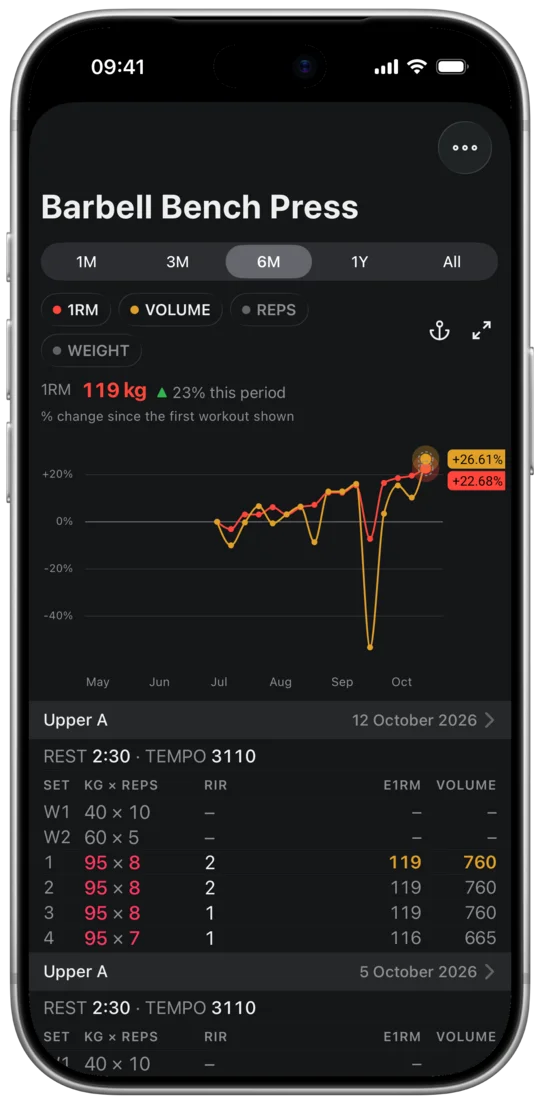
With Premium, you know what to do in your next workout: add a rep, add weight or stay at your current target.
This is Lower B from the upper/lower plan for intermediates. You can paste it through plan import (Workout > My Plans > “+” > “Import plan”); import costs 10 AI credits, so the welcome credits cover it.
DAY: Lower B- Machine Hack Squat | WU 2x8 | 3x8-12 RIR 1 | TEMPO 3010 | REST 150- Barbell Hip Thrust | 3x8-12 RIR 2 | TEMPO 2011 | REST 120- Dumbbell Walking Lunges | 2x8-12 RIR 2 | TEMPO 2010 | REST 90- Seated Leg Curl | 3x10-15 RIR 1 | TEMPO 2011 | REST 90- Seated Calf Raise | 3x10-15 RIR 1 | TEMPO 2210 | REST 60The plan creator help article shows how to lay out the weeks, including the lighter one.
Log it in SmartWorkout
A free workout log for iPhone and Android: sets, RIR, tempo, exercise groups and plans.


Questions
What is supercompensation?
Supercompensation is a model in which performance first drops after training, then returns to the starting level and briefly rises above it, and falls back again if no new stimulus follows. In sport it is the simplest description of how the body responds to training.
How long does supercompensation take after strength training?
There is no single number. Strength usually returns within 1-3 days after a hard session and later after very high volume, while the biggest rebound comes after a deliberately lighter period before a test or a meet. The 36-72 h window quoted in guides has no support in research.
What does the supercompensation curve show?
The classic curve is a single line: a drop after training, recovery, a short peak above the starting level and a slow decline. The fitness-fatigue model draws two curves instead, and performance is the difference between them; that chart is higher up on this page.
Is supercompensation real?
As a principle, yes: without rest there is no progress, and a lighter period before a meet raises performance. As a clock, no: in studies, strength after one session returned to baseline rather than above it, and nobody has measured a window you have to hit with your next workout.
What is glycogen supercompensation?
It is a higher than usual glycogen store in muscles that used it up before, after a few days of a high-carbohydrate diet. This is how carb loading before a marathon works; strength training does not need it.
When should you train the same muscle again?
After a heavy barbell squat or deadlift close to failure, usually after 72 h; after machine and cable sets with 1-3 reps in reserve, after 48 h; and 2-4 light sets far from failure you can handle on back-to-back days. The training frequency page covers more.
See also
- Deload week: what it means, how often to deload and how to do itA deload (deload week) is a planned period of lighter training, usually 5-7 days, that reduces fatigue before the next training block. Coaches cut the number of sets or reps by 30-50% and stop sets further from failure. In studies, neither a lighter week nor a week off reduced muscle growth.
- Periodization in strength training: linear, undulating and block modelsPeriodization is planned variation of load, sets and reps across weeks, usually in a linear, undulating or block model. In a meta-analysis of 35 studies it produced slightly larger strength gains than a program with constant sets and reps, but no extra muscle growth.
- Mesocycle training: how long a training block lasts and how to plan oneA mesocycle (training block) is a block of several weeks, usually 4-8, built around one goal and often ending with a lighter week (deload). It is made of microcycles, usually one training week each, and several mesocycles form a macrocycle, usually a year.
- Training frequency: how many times a week to train each muscle groupTraining frequency is the number of sessions per week in which a muscle group does working sets. How often to train a muscle depends on weekly sets: with the same sets, muscles grow about the same with 1 or several sessions (meta-analysis of 25 studies). Strength improves more with 2 or more.
- Progressive overload: what it is, linear vs double progression, and how to break a plateauProgressive overload is the gradual increase of training demands, most often load, reps or sets. The ACSM advises adding 2-10% load once you do 1-2 reps over your target in two sessions in a row. In an 8-week study, adding reps built about as much muscle as adding load.
- Training to failure: when it helps and when it just adds fatigueTraining to failure means ending a set only when, despite full effort, you cannot complete the next rep through a full range of motion without changing your form. In a meta-analysis of 15 studies it built no significantly more muscle or strength than stopping short of failure, and it is clearly more fatiguing.
- Block periodization: accumulation, transmutation and realizationBlock periodization is a plan built from consecutive blocks of 2-4 weeks (accumulation up to 6), each with one main goal: accumulation (more sets), transmutation (heavier sets) and realization (fewer sets before a test). In studies it built no more muscle, and results for strength are mixed.
Sources
- Methenitis S. A Brief Review on Concurrent Training: From Laboratory to the Field. Sports (Basel). 2018;6(4):127.
- Raastad T, Hallén J. Recovery of skeletal muscle contractility after high- and moderate-intensity strength exercise. Eur J Appl Physiol. 2000;82(3):206-14.
- Thomas K, Brownstein CG, Dent J, et al. Neuromuscular Fatigue and Recovery after Heavy Resistance, Jump, and Sprint Training. Med Sci Sports Exerc. 2018;50(12):2526-2535.
- Bartolomei S, Sadres E, Church DD, et al. Comparison of the recovery response from high-intensity and high-volume resistance exercise in trained men. Eur J Appl Physiol. 2017;117(7):1287-1298.
- MacDougall JD, Gibala MJ, Tarnopolsky MA, et al. The time course for elevated muscle protein synthesis following heavy resistance exercise. Can J Appl Physiol. 1995;20(4):480-6.
- Katz A. A century of exercise physiology: key concepts in regulation of glycogen metabolism in skeletal muscle. Eur J Appl Physiol. 2022;122(8):1751-1772.
- Hingst JR, Bruhn L, Hansen MB, et al. Exercise-induced molecular mechanisms promoting glycogen supercompensation in human skeletal muscle. Mol Metab. 2018;16:24-34.
- Hyldahl RD, Chen TC, Nosaka K. Mechanisms and Mediators of the Skeletal Muscle Repeated Bout Effect. Exerc Sport Sci Rev. 2017;45(1):24-33.
- Travis SK, Mujika I, Gentles JA, et al. Tapering and Peaking Maximal Strength for Powerlifting Performance: A Review. Sports (Basel). 2020;8(9):125.
- Imbach F, Sutton-Charani N, Montmain J, et al. The Use of Fitness-Fatigue Models for Sport Performance Modelling: Conceptual Issues and Contributions from Machine-Learning. Sports Med Open. 2022;8(1):29.
- Bettariga F, Newton RU, Bishop C, et al. Periodizing Exercise Medicine Prescription for Patients with Cancer: A Narrative Opinion. Sports Med. 2025;55(12):2987-2999.
- Brown N, Bubeck D, Haeufle DFB, et al. Weekly Time Course of Neuro-Muscular Adaptation to Intensive Strength Training. Front Physiol. 2017;8:329.
- Vermeire K, Ghijs M, Bourgois JG, et al. The Fitness-Fatigue Model: What's in the Numbers? Int J Sports Physiol Perform. 2022;17(5):810-813.
- Coleman M, Burke R, Augustin F, et al. Gaining more from doing less? The effects of a one-week deload period during supervised resistance training on muscular adaptations. PeerJ. 2024;12:e16777.
- Refalo MC, Helms ER, Hamilton DL, et al. Influence of Resistance Training Proximity-to-Failure, Determined by Repetitions-in-Reserve, on Neuromuscular Fatigue in Resistance-Trained Males and Females. Sports Med Open. 2023;9(1):10.
- Vieira JG, Sardeli AV, Dias MR, et al. Effects of Resistance Training to Muscle Failure on Acute Fatigue: A Systematic Review and Meta-Analysis. Sports Med. 2022;52(5):1103-1125 (online 2021).
- Bjørnsen T, Wernbom M, Løvstad A, et al. Delayed myonuclear addition, myofiber hypertrophy, and increases in strength with high-frequency low-load blood flow restricted training to volitional failure. J Appl Physiol (1985). 2019;126(3):578-592 (online 2018).
- Hwang PS, Andre TL, McKinley-Barnard SK, et al. Resistance Training-Induced Elevations in Muscular Strength in Trained Men Are Maintained After 2 Weeks of Detraining and Not Differentially Affected by Whey Protein Supplementation. J Strength Cond Res. 2017;31(4):869-881.
- Bosquet L, Montpetit J, Arvisais D, et al. Effects of tapering on performance: a meta-analysis. Med Sci Sports Exerc. 2007;39(8):1358-65.
- Kiely J. Periodization Theory: Confronting an Inconvenient Truth. Sports Med. 2018;48(4):753-764.