
Mesocycle, microcycle and macrocycle in numbers
A mesocycle is a training block of several weeks, usually 4-8, with one goal; in the gym, "mesocycle" and "training block" mean the same thing.
| Cycle | Length | In the gym | Source |
|---|---|---|---|
| Microcycle | usually a week | your training week, e.g. 4 upper/lower days | Evans 2019 |
| Mesocycle (block) | usually 4-8 weeks, often with a lighter week at the end | one block in a plan, e.g. 6 weeks with a calibration week and a deload | coaching practice: a planned deload every 4-8 weeks, usually at the end of a block (Bell et al. 2023) |
| Macrocycle | usually a year | several blocks arranged around a goal or a date | Evans 2019 |
Microcycle: one week of training
A microcycle is the shortest repeating unit of a plan, in the gym usually one week of training (Evans 2019). When your sessions don't fit into a week, e.g. A and B alternating every other day, one full rotation is the microcycle.
Macrocycle: the plan for a year
A macrocycle is the whole plan for a season, made of several mesocycles; in the Evans 2019 review it usually lasts a year. If you don't compete, you simply line up blocks and between them change what isn't improving: in the chart above, the second block gives the stalled muscle group 2 more sets, and the third is a strength block with sets of 4-6 reps. How to order blocks toward one goal is covered on the training periodization page.
Why split training into blocks
A plan split into blocks doesn't build more muscle than a plan that stays the same: in a meta-analysis of 35 volume-equated studies, planned changes in weight and reps gave a little more strength but not more muscle (Moesgaard et al. 2022). Blocks give you a date to compare results and change the plan, and a place for a lighter week.
| Your situation | Which block |
|---|---|
| First year, weight goes up every week | the same week with no end date, or an 8-week block without a planned deload |
| You train for physique 3-5 times a week | 6-8 week blocks with a calibration week and a deload at the end |
| You want strength in the Barbell Squat, Barbell Bench Press and Deadlift | 4-6 week blocks with rising %1RM (linear periodization), ending with a test or a deload |
| You have a date: a meet, a test, a trip | the last block ends right before the date, and you count the earlier ones back from it |
| You're coming back after more than a month off | a 4-week block starting at RIR 3-4 and about 2/3 of your former sets, then a regular block; after several months off, start with a beginner plan (how to build a plan) |
How to plan a training block step by step
You plan a block before the first session: the goal, the number of weeks, the starting sets and a lighter last week.
- Pick one goal, e.g. muscle, strength in the three big lifts or a comeback after a break, and a block length from the table above; for your first block, take 6-8 weeks. With 10 or more sets per muscle group ending at RIR 0-1, take a shorter block, 4-6 weeks.
- Count your starting sets: the weekly average per muscle group from the last 4 weeks of your log (without a log, 6-8 sets per muscle group). For a regular muscle group, keep that number if it falls within 4-10 sets (MEV); give a priority muscle group 2-4 more sets, toward 12-18 (MAV). If you already do more and your numbers are going up, stay there. You can check the week in the volume calculator.
- Make week 1 a calibration week with RIR 1 higher: with RIR 2 in the plan, pick a weight that leaves 3 reps. You can work out the starting weight in the 1RM calculator.
- Until the second-to-last week, add reps first, then weight (double progression), with the same number of sets. During the block, add 2 sets only to a muscle group that has stalled for 3 weeks even though you end its sets at RIR 1-2 and recover well.
- Plan the last week as a deload: about 60% of the sets (4 sets become 2, 3 become 2), each ending at RIR 4. The weight stays as in the last regular week, and in a block with rising %1RM it goes back to week 1. Deload earlier only if signs of fatigue show up.
- After the block, compare your estimated 1RM from week 2 and from the second-to-last week, counting reps plus RIR (1RM calculator). If it went up, calculate the weights for the next block from the last regular week, not from the deload. If a muscle group stalled all block on hard sets, give it 2 more sets in the next block (up to 20) or change the exercise or rep range; if the sets were easy, first end them closer to failure.
Some coaches lower RIR over a hypertrophy block, e.g. 3, 2, 2, 1, 1 and a deload; we know of no studies comparing this with a constant RIR. In a hypertrophy block we keep RIR constant from week 2 to the second-to-last week, because then every extra rep in your log means progress; in a block with rising %1RM, the reserve shrinks week by week by design.
Strength and physique coaches usually take a lighter week every 4-6 weeks, most often at the end of a mesocycle (Bell et al. 2023). We put the deload at the end of the block because that's where fatigue peaks, and right after it you start a new block. In a study with a week off in the middle of 9 weeks, muscle growth was no greater and strength went up less (Coleman et al. 2024). These studies don't test how many sets to keep in a deload; 60% of the sets at RIR 4 is our practice.
In trained lifters, a set count of 1.2 times what each person had been doing before the study, taken from their training log, gave more muscle growth than a standard 22 sets (Scarpelli et al. 2022). Adding 4 or 6 sets for legs every 2 weeks gave more squat strength than a constant set count, and the difference in muscle was small at most (Enes et al. 2024). You raise strength faster with weight than with another set: the 2026 ACSM position stand links strength gains to loads of 80% 1RM or more in 2-3 sets.
Hypertrophy and strength blocks in kilograms
A strength block is shorter than a hypertrophy block, and in both the last week is lighter.
| Block | Week by week | Example in kilograms | Rest |
|---|---|---|---|
| Strength block, 4 weeks | W1 4 × 6 at 75% 1RM (about RIR 3), W2 4 × 5 at 80% (RIR 2-3), W3 4 × 4 at 85% (RIR 1-2 on the first set), W4 deload 2 × 5 at 75% (the W1 weight) | Barbell Bench Press with a 100 kg 1RM: 75 kg, 80 kg, 85 kg, 75 kg | 180-240 s |
| Hypertrophy block, 8 weeks: the 4-day upper/lower plan for intermediates | W1 calibration; W2-W7 RIR 2 on multi-joint free-weight exercises, RIR 1 on the rest; W8 deload with about 60% of the sets at RIR 4 | Barbell Squat 3 × 6-10: W1 92.5 kg × 6/6/6, W7 92.5 kg × 9/9/9, W8 92.5 kg × 7/7; next block from 100 kg × 6 at RIR 3, calculated from W7 | 180 s |
For your 1RM, use a test result from a few weeks back or an estimated 1RM from a set at RIR 1-2 (1RM calculator). If the third set in W3 ends with nothing left, do 3 reps on the fourth.
- Chest sets
- Quadriceps sets
Mesocycle vs block periodization and a plan without blocks
A mesocycle is any block of several weeks in a plan, and block periodization is one way of arranging several blocks in a row.
| Mesocycle (block) | Block periodization | Plan without blocks | |
|---|---|---|---|
| What it is | any block of several weeks with one goal and an end date; the weeks can be identical | consecutive blocks with different goals: accumulation, transmutation, realization (Issurin 2019) | the same week with no end date; weight goes up through double progression |
| Length | usually 4-8 weeks | blocks of 2-4 weeks (Lorenz and Morrison 2015) | open-ended; a lighter week only when performance drops |
| Who it's for | anyone who wants a date to compare results | advanced lifters training for strength, most often before a test or a meet | beginners in their first year |
Common mistakes
- A block with no set number of weeks. After your first year, a block without a written length gives you no date to compare results and no place for a lighter week. Enter the number of weeks and the deload week before the first session; in your first year, a steady week with progression is enough.
- New exercises mid-block. Even a different machine for the same movement is a new starting point, because the same number on the stack of another model is a different resistance. Coaches bring in new exercises with a new mesocycle (Bell et al. 2023), so change them between blocks. The exception is pain: then swap the exercise right away and start progression from scratch for that one exercise only.
- Sets with no upper limit. Each extra set gives less, and for strength the drop-off is steeper (Pelland et al. 2025). Stop adding sets at 20 a week (the top of MAV) and keep progressing with weight and reps.
- Everything up at once. When the weight goes up, sets are added and RIR drops in the same week, fatigue rises faster than performance. Change one thing from week to week: reps, weight or the number of sets.
What the research says
What we know about mesocycles comes mostly from definitions, coach consensus and surveys, so certainty is low. You often read that every block must end with a deload; comparisons are very few, and 65% of athletes thought they would progress without one.
| Study | Type and sample | Result | Limitation |
|---|---|---|---|
| Bell et al. 2023 | Delphi consensus, 21 coaches in the final round | see above | expert opinion |
| Rogerson et al. 2024 | survey, 246 strength and physique athletes, 8 years of training on average | a deload every 5.6 weeks on average, lasting 6.4 days | self-reports, self-selected sample |
| Moesgaard et al. 2022 | meta-analysis of 35 volume-equated studies | strength: ES 0.31 in favor of periodization; muscle: ES 0.13, not significant | compares periodization with a constant plan, not block lengths |
| Enes et al. 2024 | 31 trained men, about 5 years of training | +4 or +6 sets for legs every 2 weeks for 12 weeks: more squat strength; no significant differences in muscle | one muscle group, small sample, men only |
| Scarpelli et al. 2022 | 16 trained people, leg vs leg comparison | see above | small sample |
| Coleman et al. 2024 | 39 trained people, 9 weeks | see above | a complete break, not lighter training; the group with the break trained 8 weeks instead of 9; only the legs were measured |
The best block length is unknown. In a 2017 review, no study tested when the effects planned in periodization arrive, and none lasted longer than 9 months (Afonso et al. 2017).
What plans built in SmartWorkout show
So blocks from the creator usually have as many weeks as coaches suggest, but fewer than one in ten has a lighter last week. If you want a deload at the end of a block, put it in when you plan. Every number is based on at least 50 people.
How to plan a mesocycle in SmartWorkout
You plan a mesocycle in SmartWorkout in the plan creator, where each block is a tab with weeks.
- On the Workout tab, next to “My Plans”, tap “See All”, then “+” and “Create new plan”. Enter a name in “Plan name”, and under “Select load indicator” choose RIR.
- Tap “Add Block” and “Create mesocycle”. On the “Mesocycle Generator” screen, set “Number of units”, meaning sessions per week (1-6), and tap “Next”.
- On the “Define Microcycle” screen, add exercises and sets to each session, pick the “Number of weeks” (2, 4, 6, 8, 10 or 12) and tap “Next”.
- On the “Define Mesocycle” screen, each week has its own tab. The creator doesn't change the weight or sets on its own, so you set the calibration week and the deload from the steps above by hand, then tap “Save”.
- Press and hold the block tab: “Edit Block Name” gives it a name, e.g. “Block 1: hypertrophy”, and “Clone” copies the whole block as the next mesocycle. Finally, tap “Save” in the plan creator.
With Premium, you see each muscle group's sets in every week of the plan against the volume zones, so you can tell right away whether the deload drops below your usual volume.
You can paste the first week of a block through plan import (“Import plan” in the same “+” menu, 10 AI credits) and build the following weeks in the creator by cloning the week.
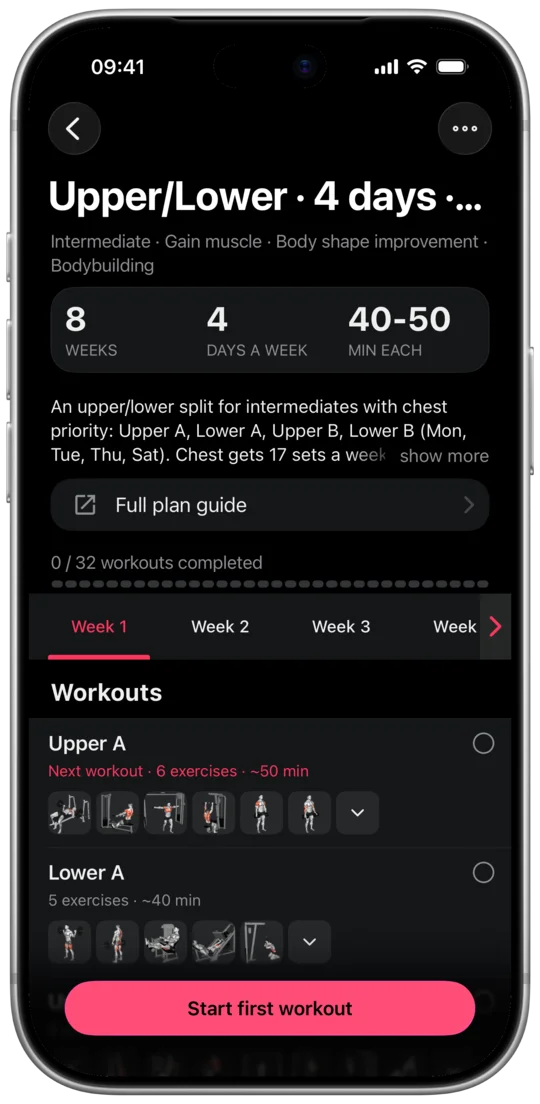
DAY: Upper A- Barbell Bench Press | WU 2x5 | 3x6-10 RIR 3 | TEMPO 20X0 | REST 180- Barbell Bent Over Row | 3x6-10 RIR 3 | TEMPO 2010 | REST 150- Seated Dumbbell Shoulder Press | 3x8-12 RIR 3 | TEMPO 2010 | REST 120- Cable Lat Pulldown | 3x8-12 RIR 2 | TEMPO 2011 | REST 120- Cable Middle Chest Fly | 2x10-15 RIR 2 | TEMPO 2011 | REST 60These are the first five exercises of the Upper A day from week 1, the calibration week, of the 4-day upper/lower plan. You can see several blocks in one plan in the free full body to split plan: 4 blocks of 2 weeks, each with a different training split.
The help article on the plan creator explains how blocks, weeks and the mesocycle generator work.
Log it in SmartWorkout
A free workout log for iPhone and Android: sets, RIR, tempo, exercise groups and plans.


Questions
How long is a mesocycle?
In the gym, usually 4-8 weeks; strength and physique athletes in a survey reported a lighter week every 5-6 weeks on average. If you're not sure what to pick, take 6-8 weeks; after your first year of training, with a deload in the last week.
What is the difference between a mesocycle and a microcycle?
A microcycle is the shortest repeating unit of a plan, in the gym usually one week of training, and a mesocycle is several of those weeks with one goal. An 8-week block has 8 microcycles.
Mesocycle vs macrocycle: what is the difference?
A macrocycle is the plan for a year or a season, made of several mesocycles. If you don't compete, planning block by block is enough; every 2-3 blocks, check whether your goal has changed.
What are training blocks?
Training block is another name for a mesocycle: several weeks of training with one goal. Block periodization is a separate model in which blocks with different goals follow a set order.
How is a hypertrophy block different from a strength block?
A hypertrophy block focuses on the number of sets and a strength block on the weight: the 2026 ACSM position stand links more muscle growth to 10 or more weekly sets per muscle group, the MAV zone, and strength gains to loads of 80% 1RM or more. A strength block is often shorter, 4-6 weeks.
Do you need a deload at the end of every mesocycle?
No: 65% of athletes in a survey thought they would progress without one. Don't plan one in your first year or in a block shorter than 4 weeks; after that, put a deload in the last week of the block, and if your numbers are still going up and your joints don't hurt, push it back a week.
See also
- Periodization in strength training: linear, undulating and block modelsPeriodization is planned variation of load, sets and reps across weeks, usually in a linear, undulating or block model. In a meta-analysis of 35 studies it produced slightly larger strength gains than a program with constant sets and reps, but no extra muscle growth.
- Block periodization: accumulation, transmutation and realizationBlock periodization is a plan built from consecutive blocks of 2-4 weeks (accumulation up to 6), each with one main goal: accumulation (more sets), transmutation (heavier sets) and realization (fewer sets before a test). In studies it built no more muscle, and results for strength are mixed.
- Deload week: what it means, how often to deload and how to do itA deload (deload week) is a planned period of lighter training, usually 5-7 days, that reduces fatigue before the next training block. Coaches cut the number of sets or reps by 30-50% and stop sets further from failure. In studies, neither a lighter week nor a week off reduced muscle growth.
- How to make a workout plan for the gym: exercises, sets, order and session lengthA workout plan (or workout program) is a written training week: days, exercises, sets, reps, reps in reserve (RIR) and rest. To make one, start with the number of days, then pick exercises and count weekly sets per muscle group. The 2026 ACSM position stand advises at least 2 sets per exercise and 2-3 reps in reserve.
- Training volume: what it is and what MEV, MAV and MRV meanIn hypertrophy training, training volume is the number of working sets a muscle group gets per week. In a meta-analysis of 67 studies, growth was measurable from about 4 weekly sets, with each extra set adding less; the 2026 ACSM position stand links 10 or more weekly sets to more growth.
- Progressive overload: what it is, linear vs double progression, and how to break a plateauProgressive overload is the gradual increase of training demands, most often load, reps or sets. The ACSM advises adding 2-10% load once you do 1-2 reps over your target in two sessions in a row. In an 8-week study, adding reps built about as much muscle as adding load.
- Linear periodization training: how it works and who it's forLinear periodization (or traditional periodization) is a plan in which the load rises and the reps per set fall every few weeks, e.g. from 4 × 10 at 65% of 1RM to 5 × 3 at 85% over 12 weeks. In meta-analyses it built as much muscle as undulating periodization; in one, trained lifters gained a bit less strength with it.
Sources
- Evans JW. Periodized Resistance Training for Enhancing Skeletal Muscle Hypertrophy and Strength: A Mini-Review. Front Physiol. 2019;10:13.
- Bell L, Strafford BW, Coleman M, et al. Integrating Deloading into Strength and Physique Sports Training Programmes: An International Delphi Consensus Approach. Sports Med Open. 2023;9(1):87.
- Lorenz D, Morrison S. Current concepts in periodization of strength and conditioning for the sports physical therapist. Int J Sports Phys Ther. 2015;10(6):734-47.
- Moesgaard L, Beck MM, Christiansen L, et al. Effects of Periodization on Strength and Muscle Hypertrophy in Volume-Equated Resistance Training Programs: A Systematic Review and Meta-analysis. Sports Med. 2022;52(7):1647-1666.
- Currier BS, D'Souza AC, Singh MAF, et al. American College of Sports Medicine Position Stand. Resistance Training Prescription for Muscle Function, Hypertrophy, and Physical Performance in Healthy Adults: An Overview of Reviews. Med Sci Sports Exerc. 2026;58(4):851-872.
- Coleman M, Burke R, Augustin F, et al. Gaining more from doing less? The effects of a one-week deload period during supervised resistance training on muscular adaptations. PeerJ. 2024;12:e16777.
- Scarpelli MC, Nóbrega SR, Santanielo N, et al. Muscle Hypertrophy Response Is Affected by Previous Resistance Training Volume in Trained Individuals. J Strength Cond Res. 2022;36(4):1153-1157.
- Enes A, De Souza EO, Souza-Junior TP. Effects of Different Weekly Set Progressions on Muscular Adaptations in Trained Males: Is There a Dose-Response Effect? Med Sci Sports Exerc. 2024;56(3):553-563 (online 2023).
- Issurin VB. Biological Background of Block Periodized Endurance Training: A Review. Sports Med. 2019;49(1):31-39.
- Pelland JC, Remmert JF, Robinson ZP, et al. The Resistance Training Dose Response: Meta-Regressions Exploring the Effects of Weekly Volume and Frequency on Muscle Hypertrophy and Strength Gains. Sports Med. 2026;56(2):481-505 (online 2025).
- Rogerson D, Nolan D, Androulakis Korakakis P, et al. Deloading Practices in Strength and Physique Sports: A Cross-sectional Survey. Sports Med Open. 2024;10(1):26.
- Afonso J, Nikolaidis PT, Sousa P, et al. Is Empirical Research on Periodization Trustworthy? A Comprehensive Review of Conceptual and Methodological Issues. J Sports Sci Med. 2017;16(1):27-34.