Chest-focused upper/lower split: 4 days a week
Two upper and two lower sessions a week for 8 weeks, for intermediates: the chest trained three times and first on both upper days, the legs at maintenance.
This is the intermediate 4-day upper/lower split rebuilt around the chest. Both upper days open with a press: the barbell bench press on Monday and the incline dumbbell press on Thursday, followed by a cable fly on Monday and the machine chest press on Thursday. A third, lighter dose comes at the end of Saturday's lower day with dumbbell flyes, two days after Thursday and two days before Monday. The chest gets 17 sets a week. The back keeps 11 sets to balance all that pressing, and the legs drop to 9 sets per muscle, enough to hold them for 8 weeks. The week has 72 working sets, about as many as the standard version.
| Split | Days a week | Level | Weeks | Minutes | Sets a week | Equipment | In the app |
|---|---|---|---|---|---|---|---|
| Upper/lower | 4 | Intermediate | 8 | ≈40–50 | 72 | Barbell, Machines, Dumbbells | Upper/Lower · 4 days · Chest |
Track this plan for free in SmartWorkout
The same exercises, sets, reps and RIR, ready in the app. Logging, rest timer and history are free. Automatic progression suggestions: Premium.
In the app: Plans → Upper/Lower · 4 days · Chest


Good fit if
- Your chest lags behind and you want it to grow most for the next 8 weeks.
- Your weights go up every week or two, not every session.
- You can train four days a week, about 40-50 minutes each time.
Take another plan if
- You are in your first months of training: the 3-day full body plan builds the chest through the presses first.
- You want every muscle to grow evenly: take the standard 4-day upper/lower plan.
- Your shoulders hurt when you press: fix that first, since this plan presses three times a week.
Weekly schedule
| Mon | Tue | Wed | Thu | Fri | Sat | Sun |
|---|---|---|---|---|---|---|
| Upper A | Lower A | Rest | Upper B | Rest | Lower B | Rest |
Missed a day? Do the next session in order: the app runs the sessions in sequence.
Monday, Tuesday, Thursday and Saturday space the three chest sessions two or three days apart. If you move the days, keep at least one day between Upper B and the flyes on Lower B.
The plan, week 1
Week 1 is calibration: pick a weight for the bottom of each range with one more rep in reserve than later. The RIR column shows week 1 → week 2 onwards; the grid below shows what changes in weeks 2-8.
Tempo 3-0-1-0: 3 s lowering, 0 s pause in the stretch, 1 s lifting, 0 s pause in the squeeze. X: lift as fast as you can while staying in control.
What RIR means →How to read tempo →How supersets work →
| Exercise | Sets × reps | RIR | Tempo | Rest | Notes |
|---|---|---|---|---|---|
| WUWarm-up sets | 2 × 5 | – | – | 1:00 | |
A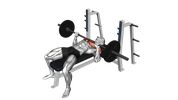 Barbell Bench Press | 4 × 6–10 | 3 → 2 | 2-0-X-0 | 3:00 | Shoulder blades pulled back and down, feet planted; touch the lower chest and press up and slightly back. |
B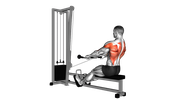 Seated Cable Row | 3 × 8–12 | 2 → 1 | 2-0-1-1 | 2:00 | |
C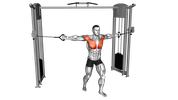 Cable Middle Chest Fly | 3 × 10–15 | 2 → 1 | 3-0-1-1 | 1:00 | Three seconds out with your arms slightly bent, then squeeze for a second with your hands together. |
D Cable Lat Pulldown | 3 × 8–12 | 2 → 1 | 2-0-1-1 | 2:00 | |
E Dumbbell Lateral Raise | 3 × 12–20 | 2 → 1 | 2-0-1-0 | 1:00 | |
F Dumbbell Biceps Curl | 3 × 10–15 | 2 → 1 | 2-0-1-0 | 1:00 |
19 working sets · ≈50 min · → Superset: go straight to the next exercise, rest after the pair
| Exercise | Sets × reps | RIR | Tempo | Rest | Notes |
|---|---|---|---|---|---|
| WUWarm-up sets | 2 × 5 | – | – | 1:00 | |
A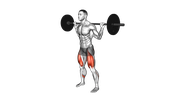 Barbell Squat | 3 × 6–10 | 3 → 2 | 2-0-X-0 | 3:00 | |
B Romanian Deadlift | 3 × 8–12 | 3 → 2 | 3-0-1-0 | 2:30 | |
C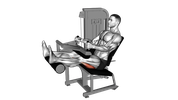 Seated Leg Curl | 3 × 10–15 | 2 → 1 | 2-0-1-1 | 1:30 | |
D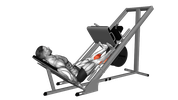 Calf Leg Press | 3 × 10–15 | 2 → 1 | 2-2-1-0 | 1:00 | |
E Kneeling Cable Abs Crunches | 2 × 10–15 | 2 → 1 | 2-0-1-1 | 1:00 |
14 working sets · ≈40 min · → Superset: go straight to the next exercise, rest after the pair
| Exercise | Sets × reps | RIR | Tempo | Rest | Notes |
|---|---|---|---|---|---|
| WUWarm-up sets | 2 × 8 | – | – | 1:00 | |
A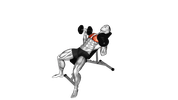 Incline Dumbbell Bench Press | 4 × 8–12 | 3 → 2 | 2-0-X-0 | 2:00 | Bench at about 30 degrees; lower the dumbbells to the sides of your upper chest. |
B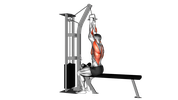 Cable Neutral Grip Lat Pulldown | 3 × 8–12 | 2 → 1 | 2-0-1-1 | 2:00 | |
C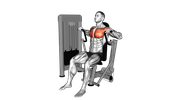 Machine Chest Press | 3 × 8–12 | 2 → 1 | 2-0-1-0 | 2:00 | |
D Chest Supported Machine Row | 2 × 8–12 | 2 → 1 | 2-0-1-1 | 2:00 | |
E1 Cable Lateral Raise | 3 × 12–20 | 2 → 1 | 2-0-1-0 | → | |
E2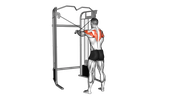 Cable Rear Delt Fly | 3 × 12–20 | 2 → 1 | 2-0-1-1 | 1:00 | |
F1 Cable Overhead Triceps Extension | 2 × 10–15 | 2 → 1 | 3-0-1-0 | → | |
F2 Seated Incline Biceps Curl | 2 × 10–15 | 2 → 1 | 3-0-1-0 | 1:00 |
22 working sets · ≈50 min · → Superset: go straight to the next exercise, rest after the pair
| Exercise | Sets × reps | RIR | Tempo | Rest | Notes |
|---|---|---|---|---|---|
| WUWarm-up sets | 2 × 8 | – | – | 1:00 | |
A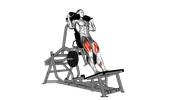 Machine Hack Squat | 3 × 8–12 | 2 → 1 | 3-0-1-0 | 2:30 | |
| BSeated Leg Curl | 3 × 10–15 | 2 → 1 | 2-0-1-1 | 1:30 | |
C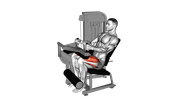 Seated Leg Extension Machine | 3 × 10–15 | 2 → 1 | 2-0-1-1 | 1:30 | |
D Seated Calf Raise | 3 × 10–15 | 2 → 1 | 2-2-1-0 | 1:00 | |
E Dumbbell Chest Fly | 3 × 10–15 | 2 → 1 | 3-1-1-0 | 1:00 | It comes at the end of a leg day, so the chest is fresh. Lower slowly and pause in the stretch for a second. |
| FKneeling Cable Abs Crunches | 2 × 10–15 | 2 → 1 | 2-0-1-1 | 1:00 |
17 working sets · ≈40 min · → Superset: go straight to the next exercise, rest after the pair
Track this plan for free
Week by week
| W1 | W2 | W3 | W4 | W5 | W6 | W7 | W8 | |
|---|---|---|---|---|---|---|---|---|
| Phase | Calibration | Build | Build | Build | Build | Build | Build | Deload |
| RIR | 3 / 2 | 2 / 1 | 2 / 1 | 2 / 1 | 2 / 1 | 2 / 1 | 2 / 1 | 4 |
| Working sets | 72 | 72 | 72 | 72 | 72 | 72 | 72 | 45 |
| What to do | Find your weights | Reps, then weight | Reps, then weight | Reps, then weight | Reps, then weight | Reps, then weight | Reps, then weight | Same weights, half the sets |
| Done: Upper A | ||||||||
| Done: Lower A | ||||||||
| Done: Upper B | ||||||||
| Done: Lower B |
Week 8 is a deload: about 60% of the sets (4→2, 3→2, 2→1), the same weights and rest, stop at RIR 4. Why a deload helps →
Saved only in this browser. The app keeps your weights and reps.
Worked example: Barbell Bench Press
Sample numbers of a simulated lifter, worked through with the manual rule on this page.
| Week | Weight | Reps per set | RIR | Next session |
|---|---|---|---|---|
| 1 | 72.5 kg | 6 · 6 · 6 · 6 | 3 | Calibration done: add reps |
| 2 | 72.5 kg | 7 · 7 · 7 · 7 | 3 | Add reps |
| 3 | 72.5 kg | 8 · 8 · 8 · 8 | 2 | Add reps |
| 4 | 72.5 kg | 9 · 9 · 8 · 8 | 2 | Add reps |
| 5 | 72.5 kg | 9 · 9 · 9 · 8 | 2 | Add reps |
| 6 | 72.5 kg | 9 · 9 · 9 · 9 | 2 | Add reps |
| 7 | 72.5 kg | 10 · 10 · 9 · 9 | 2 | Next week: deload |
| 8 | 72.5 kg | 8 · 8 | 4 | Next run starts at 77.5 kg |
How to progress on this plan
The simplest method that works on any plan: double progression. Keep the weight and add reps while you finish your sets with the reserve in the RIR column. When every set reaches the top of the range, add one step and build the reps up again.
- Barbell Bench Press 4 × 6–10 at RIR 2: when all 4 sets reach 10 reps at RIR 2 or easier, add 2.5 kg next session.
- Seated Cable Row 3 × 8–12 at RIR 1: when all 3 sets reach 12 reps at RIR 1 or easier, add 2.5 kg next session.
- Cable Lat Pulldown 3 × 8–12 at RIR 1: when all 3 sets reach 12 reps at RIR 1 or easier, add 2.5 kg next session.
- Barbell Squat 3 × 6–10 at RIR 2: when all 3 sets reach 10 reps at RIR 2 or easier, add 2.5 kg next session.
- Romanian Deadlift 3 × 8–12 at RIR 2: when all 3 sets reach 12 reps at RIR 2 or easier, add 2.5 kg next session.
- Incline Dumbbell Bench Press 4 × 8–12 at RIR 2: when all 4 sets reach 12 reps at RIR 2 or easier, add 2 kg next session.
- Isolation exercises (10–20 reps) follow the same rule. With light dumbbells, the next pair can be too big a jump: use the in-between weight, or stay and go 1-2 reps above the range for a week or two.
- The barbell bench press leads Monday with 4 sets of 6-10 at RIR 2. It comes once a week, so expect about a rep a week and the first 2.5 kg step late in the block.
- The incline dumbbell press leads Thursday with 4 × 8-12. Dumbbell steps are big for a press: right after a step your reps drop back toward 8, which is normal.
- The flyes are done slowly, three seconds down, and the dumbbell flyes pause for a second in the stretch. Keep that tempo when you add weight: the stretch is where flyes work the chest hardest.
- Free-weight compounds (both presses, squat, Romanian deadlift) stop at RIR 2; machines, cables and isolation exercises at RIR 1.
What to do next session
| You logged | Next session |
|---|---|
| All sets at the top of the range with the planned reserve | One weight step up |
| Below the top, with the planned reserve | Same weight, +1 rep on the sets that allow it |
| One rep less in reserve than planned | Same weight and reps: repeat the session |
| Sets below the range, or RIR 0 when the target was 2 | Keep the weight; if sets fell below the range, one step down |
| No progress for 2 sessions | Check rest and honest RIR; after a 3rd session, about −10% and build back up |
Your starting weights
Enter a recent set of the exercise: weight, reps and how many reps you had left. You get the week-1 weight for the bottom of the range with one rep more in reserve, from the widely used RPE chart (RTS).
Weekly volume per muscle
Working sets per muscle in a regular week, counted the way the app counts them: a set is 1 for a muscle the exercise trains directly and 0.5 for one it trains indirectly. Warm-ups don't count.
- Chest17 · 3×/wk
- Back11 · 2×/wk
- Quadriceps9 · 2×/wk
- Hamstrings9 · 2×/wk
- Gluteus7.5 · 1×/wk
- Side delts6 · 2×/wk
- Rear delts5.5 · 1×/wk
- Biceps5 · 2×/wk
- Triceps9 · 1×/wk
- Front delts8.5 · 0×/wk
- Calves6 · 2×/wk
- Abs4 · 2×/wk
- Trapezius5.5 · 1×/wk
- Lower Back3 · 1×/wk
Abs and calves are optional. From 10 sets a week the app labels a muscle "High volume": above its default target and still productive.
Substitutions
Choose your substitute in week 1 and keep it for all 8 weeks: the app tracks progress per exercise. Each substitute trains the same muscles directly, so the volume above stays the same.
Adapt the plan
- Short on time
- Drop the crunches on the lower days, the calf raises, the curl on Upper A or the arm superset on Upper B: each saves about 4-6 minutes. Keep every chest exercise.
- Bulking or cutting
- Keep the plan as it is in both. On a cut, aim to hold your weights: reps that drop by one or two are normal, and you can skip the last set of the isolation exercises if recovery suffers.
- Bringing up one muscle
- The chest already gets 17 sets a week. To bring up a second muscle, add 2-3 weekly sets for it on an upper day, for example lateral raises for the side delts.
- Over 40
- Warm up a little longer, keep one more rep in reserve on the heavy barbell lifts and take the full rest. Joints decide the pace, not the calendar.
- Training at home
- This plan needs a gym. At home with dumbbells and a bench, take the 4-day dumbbell upper/lower plan and add 2 sets of dumbbell flyes on each upper day.
The same plan in the app
The app opens exactly this plan: all 8 weeks, the same targets, week 1 calibration included. Its description in the app:
An upper/lower split for intermediates with chest priority: Upper A, Lower A, Upper B, Lower B (Mon, Tue, Thu, Sat). Chest gets 17 sets a week over 3 workouts: bench press and cable fly on Upper A, incline dumbbell press and machine chest press on Upper B, dumbbell fly after Lower B. Back stays at 11 sets; legs, shoulders and arms get fewer. 8 weeks: week 1 is calibration (one more rep in reserve than the target), weeks 2-7 at RIR 2 on free-weight compounds and RIR 1 on the rest, week 8: deload, about half the sets, RIR 4. Progression: add reps first, then weight once every set reaches the top of its range at the target RIR.
Free: the plan, logging weight, reps and RIR, the rest timer, history, previous results and the calculators.
This page teaches the manual method. With Premium, the app suggests the weight and reps for every set after each workout, from the weights, reps and RIR you logged, including week-1 calibration and the deload. Its suggestions can differ from this simple rule because it uses more of your data.
Track this plan for free in SmartWorkout
The same exercises, sets, reps and RIR, ready in the app. Logging, rest timer and history are free. Automatic progression suggestions: Premium.
In the app: Plans → Upper/Lower · 4 days · Chest