
Myo-reps key numbers
Myo-reps are a rest-pause method Børge Fagerli developed in 2006: after an activation set stopped 1-2 reps short of failure, you do a few short mini sets with the same weight, separated by 3-5 breaths.
| Parameter | Value | Source |
|---|---|---|
| Activation set | 5-15 reps (up to 20 in the author's protocols), RIR 1-2 | Fagerli 2023 |
| Rest before a mini set | 3-5 deep breaths (10-15 s); up to 10 breaths (about 30 s) with a heavier weight | Fagerli 2023 |
| Mini sets | 2-5 of 2-4 reps (after a 15-20 rep activation set: 3-5 reps), RIR 1-2 | Fagerli 2023 |
| When to stop | when a mini set has fewer reps than the first one or failure is close, after 5 mini sets at most | Fagerli 2023 |
| When to add weight | when, for the second session in a row, the activation set reaches the top of your range (e.g. 15 in 12-15) and you complete 5 full mini sets | our practice |
You often see the rule “3-5 reps, 3-5 mini sets, 3-5 breaths”; it isn't in the author's texts (Fagerli 2012).
- Working set
- Mini set
Activation set
The activation set is the first and longest part of Myo-reps: you keep going until the reps clearly slow down despite full effort, which means RIR 1-2 (RPE 8-9). Fagerli's idea is that each mini set that follows adds more effective reps, the hard reps close to failure; but in the only Myo-reps study that measured muscle activity (EMG), it was similar to straight sets (Bradshaw et al. 2026).
In a set of 15 reps or more, you usually have more left than you feel (how accurate RIR ratings are), and a burning muscle isn't RIR 1 yet. If your first mini set comes out at 6 reps or more, the activation set stopped too far from failure.
When Myo-reps make sense
Myo-reps didn't build more muscle or strength than straight sets. In an 8-week study with a protocol close to the author's, gains were similar, and sessions were shorter with about 30% less tonnage (Bradshaw et al. 2026). Like other intensity techniques, they're a tool for when you're short on time and for isolation exercises.
If you can't yet judge how many reps you have left, it's too early for Myo-reps, because rest-pause takes experience (Iversen et al. 2021). First do a few test sets to failure on a machine or a cable (the author advises at least 2 weeks of this). You gain the most when you train regularly and don't have time for full sets of your isolation exercises.
Myo-reps in your weekly plan
According to the author, one Myo-reps sequence with 3-4 mini sets replaces about 3 straight sets, and one with 2 mini sets replaces 2 (Fagerli 2023). Use it on an isolation exercise, the last one for that muscle group in the workout, e.g. instead of 3 sets of dumbbell lateral raises.
How to do Myo-reps step by step
- If it's the first exercise for that muscle group, do 2 warm-up sets with increasing weight, for 5-8 and 3-5 reps.
- Take a weight you can lift for 10-15 reps and do the activation set until the reps clearly slow down.
- Put the weight down or lower it and take 3-5 deep breaths.
- Do a mini set with the same weight: 3-4 reps, or 3-5 after a 15-20 rep activation set. Repeat that number in every mini set.
- Repeat the breaths and mini sets until the stop rule kicks in.
- Before the next exercise, rest as usual, 1-2 min (rest between sets).
Between mini sets, keep the dumbbells in your hands at your thighs: putting them on the floor eats half the break.
When to stop the mini sets
You end the Myo-reps mini sets when you can't match the reps of your first mini set, when you get close to muscular failure, or after 5 mini sets (Fagerli 2023).
| Author's notation (activation set + mini sets) | Verdict |
|---|---|
| 12 + 4 + 4 + 3 | right: stopped when a mini set came out a rep short |
| 8 + 3 + 3 + 3 + 3 + 3 + 3 + 3 + 3 + 3 | wrong: 9 mini sets, should have stopped after the fifth |
If you keep stopping after 2 mini sets, lengthen the break to about 10 breaths. If you keep getting 5 full mini sets with reps to spare, the author shortens the break to 1-2 breaths; we add weight instead: that way the break stays the same and your progress shows up as more kilograms.
Myo-reps examples in kg
Dumbbell lateral raises as 3 × 13 with 60 s of rest take about 4 minutes for about 40 reps; as the Myo-reps in the first row, they give 29 reps in about 2 minutes.
| Exercise | Activation set | Mini sets | Why it ended |
|---|---|---|---|
| Dumbbell Lateral Raise | 8 kg × 15, RIR 1 | 5, 5, 4 | a mini set came out a rep short |
| Seated Leg Extension Machine | 45 kg × 15, RIR 1 | 4, 4, 4, 4, 4 | 15 reps and 5 mini sets for the second time in a row: 50 kg next time |
| Machine Preacher Curl | 30 kg × 9, RIR 2 | 3, 3, 2 | a mini set came out a rep short |
Myo-reps on machines, cables and dumbbells
Myo-reps suit machines, cables and single-joint exercises, because you stay at the station between mini sets.
| Good fit | Why |
|---|---|
| Dumbbell Lateral Raise | the dumbbells stay in your hands |
| Seated Leg Extension Machine | you stay in the seat, the pin stays where it is |
| Machine Chest Fly | no barbell over your chest; flyes were used in both Myo-reps studies |
| Rope Triceps Pushdown | you stand at the cable with the rope in your hands |
| Machine Preacher Curl | your upper arm is braced, so form holds up under fatigue |
| Use with care or not at all | Why |
|---|---|
| Barbell Bench Press | used in Bradshaw et al. 2026; do mini sets only with a spotter or with the safety bars set |
| Dumbbell Bench Press | getting the dumbbells back into position before every mini set eats into your few breaths of rest (Fagerli 2023); the Plate-Loaded Chest Press works better |
| Barbell Squat | lower back fatigue breaks down your form, the same as in the Deadlift and the Barbell Bent Over Row; the Leg Press works better |
Myo-reps vs rest-pause, drop sets and cluster sets
Typical rest-pause is a few rounds to failure; Myo-reps differ from it by leaving reps in reserve and by having a stop rule (Fagerli 2023).
| Myo-reps | Rest-pause | Drop set | Cluster set | |
|---|---|---|---|---|
| Weight | the same | the same | down 20-30% per drop | the same, usually heavy |
| Break in the middle | 3-5 breaths | 15-30 s after failure | only the weight change | 15-45 s, before fatigue sets in |
| How close to failure | RIR 1-2, failure at most in the last mini set | every part to failure | to failure or close to it | with reps in reserve |
| Weekly sets in SmartWorkout | each mini set is 1 set | each mini set is 1 set | the whole sequence is 1 set | each mini set is 1 set |
How many sets Myo-reps count as
In SmartWorkout you log each Myo-reps mini set as a regular working set, so an activation set and 4 mini sets make 5 weekly sets.
Dumbbell lateral raises in such a sequence twice a week come to 10 sets for the side delts in SmartWorkout, which is MAV; by the author's conversion it's about 6, which is MEV. The seated dumbbell shoulder press also counts in full toward the side delts, so doing the day from the plan fragment below twice a week gives 16 sets, still MAV. The page on how to count sets covers the rules for all techniques, and you can work out your week with the sets per muscle group calculator.
Common mistakes
- Too heavy an activation set. With a weight you can lift for fewer than 5 reps, after 3-5 breaths you only get single heavy reps under fatigue. Take a weight you can lift for 10-15 reps, and split heavier sets as in a cluster set.
- A break as long as between sets. After 60 s, they're just straight sets. Count 3-5 breaths.
- Every mini set to failure. Failure in the first mini set usually leaves only 1-2 reps for each of the next ones, and with rest-pause to failure, perceived effort was much higher than with straight sets (Almeida et al. 2024). Save failure for the last mini set at most.
- Swinging in the mini sets. Swinging hides the moment you can no longer do a clean rep; that is already technical failure and the end of the mini sets. The author allows a shortened range of motion (Fagerli 2023), but then keep it the same every time so you can compare reps between workouts.
- Myo-reps on every exercise. Short breaks pile up fatigue in the muscle group. Keep the method for 1-2 exercises per workout, preferably isolation ones.
What the research says about Myo-reps
| Claim | What studies show | Certainty |
|---|---|---|
| More muscle or strength than straight sets | no difference in either study (8 weeks each) | low: 1 small study with the author's protocol, 1 with a different one |
| Less time | shorter sessions, about 30% less tonnage (Bradshaw et al. 2026, table below) | low: time measured in one session in 9 people |
| Rest-pause, the closest method, builds more muscle | a small advantage in one meta-analysis (Tsartsapakis et al. 2026), no difference in a second one pooling all techniques (Fonseca et al. 2023); rest-pause studies usually went to failure at 75-80% 1RM | low |
| Study | Type and sample | Result | Limitation |
|---|---|---|---|
| Bradshaw et al. 2026 | 22 trained men, 8 weeks | no difference in muscle or strength; in the single-session part, the workout was shorter and muscle activity (EMG) similar | chest only |
| Rezaei et al. 2026 | 36 trained men, 8 weeks | rectus femoris thickness: Myo-reps +4.8%, straight sets +2.2%, both combined +12.1% (significantly more than straight sets); no difference in strength | different protocol: activation set at 50% 1RM, heavier mini sets at 75-85% 1RM; not indexed in PubMed |
It's unknown how Myo-reps work in women, in beginners and over more than 8 weeks, and finding no difference in samples this small doesn't prove the methods are equal (Rios et al. 2026).
How to log Myo-reps in SmartWorkout
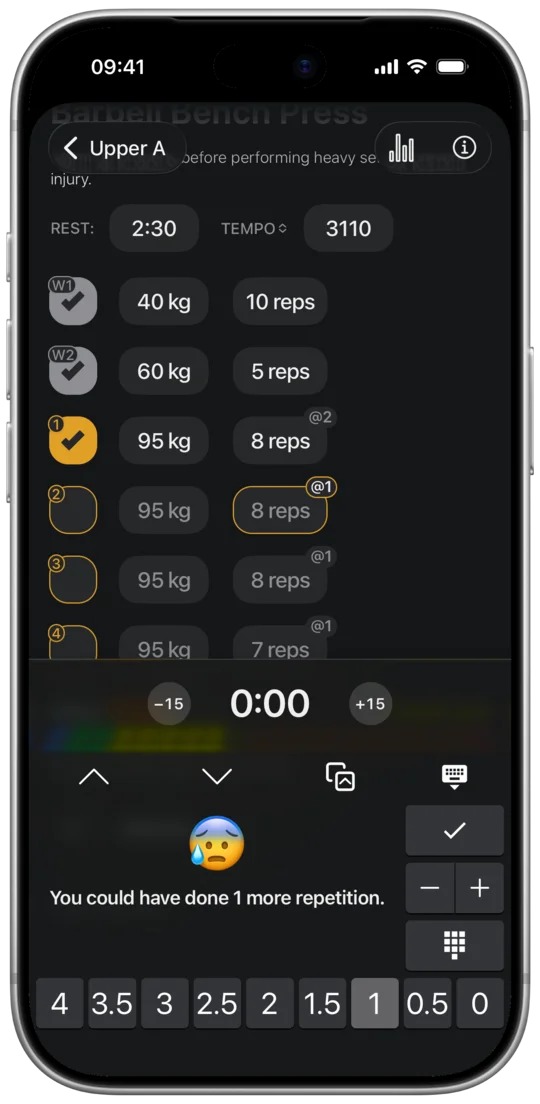
You log Myo-reps in SmartWorkout as regular working sets with 15 s of rest; there's no separate set type for Myo-reps to choose.
- Enter the activation set: weight, reps and RIR 1 or 2 (RPE 9 or 8).
- In the set's menu, tap “Set rest timer” and choose 15 s.
- Check off the set: the 15 s timer starts on its own.
- Tap “Add Set”: the new set copies the rest and the weight from the previous one and suggests its reps, so enter the number you did in your mini set.
- After the last mini set, delete the extra sets (“Remove set” in the set's menu) and lengthen the rest with the “+” button.
The help article on set types and exercise groups explains how set types and rest work.
With Premium, progression suggestions recognize mini sets with less than 45 s of rest and leave the weight to you: you add it following the last row of the parameters table.
You can paste this fragment through plan import (Workout > My Plans > “+” > “Import plan”). Import costs 10 AI credits, so the welcome credits cover it.
DAY: Shoulders and arms- Seated Dumbbell Shoulder Press | WU 1x10 | 3x8-10 RIR 2 | TEMPO 2010 | REST 120- Dumbbell Lateral Raise | 1x15-20 RIR 1 + 4x3-5 RIR 1 | TEMPO 2010 | REST 15- Machine Preacher Curl | 1x10-12 RIR 1 + 4x3-4 RIR 1 | TEMPO 2010 | REST 15- Rope Triceps Pushdown | 3x10-12 RIR 1 | TEMPO 2010 | REST 90Log it in SmartWorkout
A free workout log for iPhone and Android: sets, RIR, tempo, exercise groups and plans.


Questions
What is a myo rep?
Myo-reps are a rest-pause method Børge Fagerli developed in 2006: after an activation set stopped 1-2 reps short of failure, you do a few short mini sets with the same weight, separated by 3-5 breaths.
What is the difference between Myo-reps and rest-pause?
Myo-reps are a type of rest-pause that leaves 1-2 reps in reserve in every part and has a rule for when to stop. If you want to reach failure several times in a row, that's classic rest-pause.
How many mini sets should you do with Myo-reps?
Plan on 3-4 and stop earlier once a mini set comes out a rep short of the first one; the method's author never goes past 5. By his estimate, a sequence with 3-4 mini sets replaces roughly 3 straight sets.
Do Myo-reps actually work better than straight sets?
Not better, just similar: in an 8-week study in trained men, muscle and strength grew about the same, with no significant difference. You gain time: in the dumbbell lateral raise example, the exercise takes 2 minutes instead of 4.
Myo-reps vs drop sets: which is better?
Both shorten your workout with gains similar to straight sets. A drop set adds reps with less and less weight to failure, usually on the last set on a pin-loaded machine. Myo-reps stay with the same weight and 1-2 reps in reserve and replace all the straight sets of one exercise, e.g. 3 sets of dumbbell lateral raises.
How long should you rest between Myo-reps mini sets?
Count 3-5 deep breaths, about 10-15 s; with a heavier weight the author allows up to 10 breaths, about 30 s. If even that isn't enough for the next mini set, take a lighter weight.
See also
- Rest-pause sets: what they are and how to do themA rest-pause set is a set taken to muscular failure, followed by a 20-30 s pause and more reps with the same weight, usually 1-2 times. In studies it built muscle about as well as straight sets in less time, and in some studies it added slightly more strength.
- Drop sets: what they are, how to do them and how much weight to dropA drop set (also called a strip set or descending set) is a set taken to or near failure, then continued without rest after cutting the weight by about 20-30%. In meta-analyses, drop sets built about as much muscle as regular sets in less time. One drop on the last set is usually enough.
- Cluster sets in lifting: what they are and how to use themA cluster set is one set split into mini sets of 1-5 reps with short rests inside the set, usually 15-45 s. In meta-analyses, cluster sets built strength and muscle about as well as traditional sets, with less velocity loss and less fatigue during the session.
- How to count sets per muscle group: direct, indirect and warm-up setsCounting sets per muscle group (fractional set counting) means adding up a week's working sets: 1 for the muscle that mainly does the movement, 0.5 for a muscle that clearly assists, 0 for warm-up sets. In a meta-analysis of 67 studies, this matched muscle growth better than counting assisting muscles as 1 or 0.
- RIR (reps in reserve): what it means and how to estimate itRIR (reps in reserve) is the number of good reps left before failure when a set ends. RIR 0 means no reps left, and RIR 2-3 in a plan means ending the set with 2-3 reps still in the tank. In a meta-analysis of 12 studies, lifters had on average 1 rep more left than they thought.
- Training to failure: when it helps and when it just adds fatigueTraining to failure means ending a set only when, despite full effort, you cannot complete the next rep through a full range of motion without changing your form. In a meta-analysis of 15 studies it built no significantly more muscle or strength than stopping short of failure, and it is clearly more fatiguing.
- Rest between sets: how long to rest for hypertrophy, strength and fat lossRest between sets (rest interval) is the time from the end of one set to the start of the next. For hypertrophy, 1.5-2 minutes is usually enough, 2-3 minutes on heavy lifts and 3-5 minutes for sets of 1-5 reps. In a meta-analysis of 9 studies, rests shorter than a minute produced slightly less muscle.
- Training volume: what it is and what MEV, MAV and MRV meanIn hypertrophy training, training volume is the number of working sets a muscle group gets per week. In a meta-analysis of 67 studies, growth was measurable from about 4 weekly sets, with each extra set adding less; the 2026 ACSM position stand links 10 or more weekly sets to more growth.
Sources
- Fagerli BA. Myo-reps: a time-efficient method for maximum muscle growth. borgefagerli.com; first version 2006, revised May 2023 (Internet Archive copy of 12 March 2026).
- Fagerli BA. Myo-reps in English. borgefagerli.com; 1 May 2012 (Internet Archive copy of 25 October 2012).
- Bradshaw JT, Sanzo K, Barakat C, et al. Similar Strength and Hypertrophic Adaptations in Less Time? Myo-Reps vs. Traditional Straight-Sets in Resistance-Trained Men. J Strength Cond Res. 2026;40(6):638-649.
- Rezaei B, Amani Shalmazari S, Rajabi H, Tartibian B. Combined Myo-Reps and Traditional Resistance Training Promotes Greater Muscle Hypertrophy Without Altering Acute Decorin and Interleukin-1β Responses in Resistance-Trained Men. New Approaches in Exercise Physiology. 2026;8(16):176-210.
- Iversen VM, Norum M, Schoenfeld BJ, et al. No Time to Lift? Designing Time-Efficient Training Programs for Strength and Hypertrophy: A Narrative Review. Sports Med. 2021;51(10):2079-2095.
- Almeida GPL, João GA, Charro MA, et al. How do rest-pause and sarcoplasma stimulating training models affect metabolic and psychoaffective responses in bodybuilding athletes compared to traditional training? Front Sports Act Living. 2024;6:1467762.
- Tsartsapakis I, Zafeiroudi A, Kouthouris C. Effects of Advanced Resistance Training Systems on Muscle Hypertrophy and Strength in Recreationally Trained Adults: A Systematic Review and Meta-Analysis. J Funct Morphol Kinesiol. 2026;11(1).
- Fonseca PAB, Ide BN, Oranchuk DJ, et al. Comparison of Traditional and Advanced Resistance Training Paradigms on Muscle Hypertrophy in Trained Individuals: A Systematic Review and Meta-Analysis. Transl Sports Med. 2023;2023:9507977.
- Rios MJ, Ferreira FA, Chapman DW, et al. Methods and Systems of Resistance Training: A Narrative Review Based on Contemporary Recommendations. Sports (Basel). 2026;14(8):348.