
Rest-pause key numbers
A rest-pause set is a set to failure that you continue after a short pause with the same weight, again to failure (Fonseca et al. 2023).
| Parameter | Value | Source |
|---|---|---|
| Weight | one you can lift for 8-12 reps to failure (75-80% 1RM) | Enes et al. 2023, Marshall et al. 2012; conversion to %1RM: Iversen et al. 2021 |
| Pause within the set | 20-30 s | Marshall et al., Vargas-Molina et al. 2026; the review by Rios et al. 2026: 10-30 s |
| Effort | every part to failure (RIR 0) | Tsartsapakis et al. 2026 |
| Mini sets after the first part | 1-2, 16-20 reps in total | Enes et al. 2023 (16), Prestes et al. 2019 (18), Marshall et al. (20); the number of mini sets is our practice |
| Where in the workout | the whole exercise or its last set; 1-2 exercises | Prestes et al., Vargas-Molina et al.; the number of exercises is our practice |
- Working set
- Mini set
When rest-pause sets make sense
Like other intensity techniques, rest-pause builds muscle about as well as straight sets (Fonseca et al. 2023), in less time and at the cost of more fatigue. It's a tool for 1-2 exercises on a machine or a cable, not the basis of your plan.
After a 20-30 s pause every rep is close to failure again, so in under a minute you add a few effective reps without the 2-minute rest before another set; according to the review by Rios et al. 2026, that is the method's whole advantage.
| Situation | Rest-pause | What studies show |
|---|---|---|
| Strength | as an add-on to heavy sets | more strength in 2 of 4 studies, the same in 2 |
| Short on time | yes | 35 instead of 57 minutes per workout (Iversen et al. 2021, describing the study by Prestes et al.) |
| Reps have stalled | yes, on the last set | the first progression step in Vargas-Molina et al. 2026 |
| First months of training | no | the method takes experience (Iversen et al.) |
Start with the last set of one exercise, and after a few weeks add a second exercise or do a whole exercise as one rest-pause set; skip it in a deload week.
For example, a rest-pause set of 60 kg × 10 + 4 + 2 takes about 90 s, while the same 16 reps as two straight sets of 8 with 2 minutes of rest take about 3 minutes.
Don't use rest-pause on a muscle group you train again the next day, or before a strength test: training to failure on every set stretched recovery to 24-48 hours (Morán-Navarro et al. 2017).
How to do a rest-pause set step by step
- Pick an exercise where failure carries no risk: a machine, a cable, a pull-up bar or dumbbells in an isolation exercise.
- If it's the first exercise for that muscle group, do 1-2 warm-up sets.
- Take a weight you can lift for 8-12 reps and go to muscular failure, that is RIR 0.
- Put the weight down for 20-30 s without leaving the station, then do more reps to failure with the same weight; on a machine, don't move the pin.
- If you're still short of your target, e.g. 18 reps in total, do a second mini set and stop there.
- Rest about 2 minutes before the next exercise (rest between sets).
Rest-pause examples in kg
In these examples the target is 18 reps in total, and each part goes to failure after a 20-30 s pause. At first you'll usually fall 1-2 reps short of it.
| Exercise | First part | Mini sets |
|---|---|---|
| Wide Grip Lat Pulldown | 55 kg × 10 | 55 kg × 4, then × 2 |
| Plate-Loaded Chest Press | 60 kg × 10 | 60 kg × 4, then × 2 |
| Dumbbell Lateral Raise | 8 kg × 12 | 8 kg × 4, then × 3 |
| Pull-Up | bodyweight × 10 | × 4, then × 3 |
Measure progress by the total target: once you hit 18 reps in two parts, or the first part goes past the top of the rep range, add the smallest step, as in double progression: one pin on the stack, 1-2 kg on dumbbells, a 1.25-2.5 kg plate on a dip belt for pull-ups.
Rest-pause on machines, cables and the pull-up bar
Rest-pause is safest on machines and cables; for multi-joint exercises, Iversen et al. 2021 advise less experienced lifters to use machines.
| Good fit | Why |
|---|---|
| Wide Grip Lat Pulldown | you let go of the bar and stay under the thigh pads |
| Dumbbell Lateral Raise | you hold the light dumbbells at your thighs during the pause |
| Pull-Up | you drop off the bar and jump back up during the pause |
| Plate-Loaded Chest Press | multi-joint with no barbell over you |
| Leg Press | you lock the sled during the pause; set the safety stops in case you fail |
| Better not | Why |
|---|---|
| Barbell Squat, Deadlift | failure with a free weight, and your form gives out before your muscles; instead of the squat, use the Machine Hack Squat |
| Barbell Bench Press | only with safety bars or a spotter; without them, use the Machine Chest Press |
Rest-pause vs Myo-reps, cluster sets and drop sets
Rest-pause differs from a cluster set in when the pause comes: in rest-pause after failure, in a cluster set before it (Tsartsapakis et al. 2026).
| Rest-pause | Myo-reps | Cluster set | Drop set | |
|---|---|---|---|---|
| Weight | the same | the same | the same, usually heavier | lower after each drop |
| Pause within the set | 20-30 s after failure | 3-5 breaths, 10-15 s (Fagerli 2023) | 15-45 s, planned before failure | only to change the weight |
| Effort | every part to failure | RIR 1-2, failure at most in the last mini set | usually with reps in reserve | to failure or close to it |
| Weekly sets in SmartWorkout | each mini set is 1 | each mini set is 1 | each mini set is 1 | the whole sequence is 1 |
Three methods called rest-pause
The name rest-pause also covers two methods closer to a cluster set, because they split the set into single reps:
- heavy singles: 4-6 reps with a weight close to 1RM (Iversen et al. 2021), in Mike Mentzer's version usually 4 with 10-15 s breaks (Holman 2014);
- a pause after every rep: 4 s in Korak et al. 2017, which the 2026 ACSM position stand calls rest redistribution.
How to count rest-pause mini sets in weekly sets
In SmartWorkout, each rest-pause mini set is a separate working set, because that's how you log it. This matches the definition of a set in the 2026 ACSM position stand: a group of reps performed without rest.
Studies count this differently, and when you plan your week, count a set with its mini sets as 1 set, as Enes et al. 2023 did (3 × 16 is 3 sets). Rest-pause with 2 mini sets on the last of 3 sets is 5 sets in SmartWorkout and 3 in your weekly plan, so don't use mini sets to reach your weekly zone target. You can work out your week with the sets per muscle group calculator, and the page on how to count sets covers the rules for all techniques.
Common mistakes
- Adding up the reps into one set. Logging 60 kg × 16 instead of 10, 4 and 2 gives the same tonnage, but your estimated 1RM jumps from 78 to 87 kg, and your rep record loses its meaning. Log each part separately.
- Too long a pause. After a minute of rest, they're just straight sets. Stick to 20-30 s.
- A weight outside the range. At 20 reps or more, burning or running out of breath ends the set before failure, and with a weight for 5 reps or fewer the mini sets turn into singles. For lateral raises, take a weight you can lift for 12-15 reps.
- Rest-pause on every exercise. After such a workout, perceived effort was 8.5 vs 6.0 after straight sets (Almeida et al. 2024). Keep the method for 1-2 exercises.
- Partial reps in the mini sets. Swinging and a shortened range of motion add reps only in your log, and Vargas-Molina et al. 2026 counted full reps only. Once the range shrinks, that's technical failure and the end of that part.
What the research says about rest-pause
| Claim | What studies show | Certainty (our rating) |
|---|---|---|
| More muscle | a small advantage in one meta-analysis, but in studies where the straight sets ended far from failure; none in another (10 studies in trained lifters, Fonseca et al. 2023) or with matched tonnage (Enes et al. 2021) | low |
| More strength | in 2 of 4 studies of classic rest-pause (Enes et al. 2021; Karimifard et al. 2023, not indexed in PubMed), the same in 2 | low |
| More fatigue | higher perceived effort after one workout (Almeida et al. 2024); over 8 weeks the same session effort but higher training monotony, meaning less variation in load from day to day (Enes et al. 2023); strength came back after 5 minutes as after straight sets (Marshall et al. 2012); recovery after rest-pause alone wasn't measured | low |
| Study | Type and sample | Result | Limitation |
|---|---|---|---|
| Tsartsapakis et al. 2026 | meta-analysis, 23 studies, recreationally trained adults | techniques combined: muscle g = 0.046, strength g = 0.351; rest-pause the only technique with a significant advantage for muscle | 4 rest-pause studies: in Prestes et al. the straight sets were 6 reps with a weight for 8-12 (Iversen et al. 2021); Korak et al. used 4 s pauses with no muscle measurement; Karimifard et al. not indexed in PubMed |
| Enes et al. 2021 | 28 trained men, 8 weeks, matched tonnage (rest-pause 10 + 6 after 20 s, 75% 1RM) | no difference in muscle; higher squat 1RM after rest-pause | 9-10 people per group |
It's unknown whether rest-pause builds more muscle than straight sets taken just as close to failure: the studies lasted 6-12 weeks, had 9-12 people per group and almost only men.
How to log rest-pause sets in SmartWorkout
You log rest-pause in SmartWorkout as regular working sets with a short rest, each part separately; there's no separate set type for this technique.
- If you only do rest-pause on the last set, go to “Workout Settings” and under “Rest time entry” choose “Per set”.
- Before the first part, open the set's menu, tap “Set rest timer” and choose 30 s.
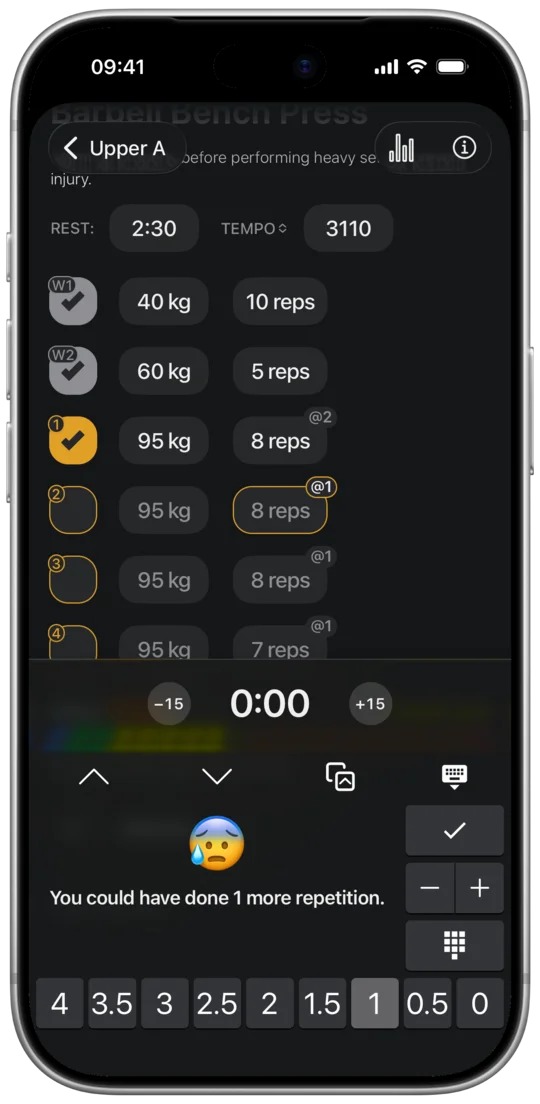
- After the set to failure, enter the weight, the reps and RIR 0 (“Maximal effort. You could not have done another repetition.”), then check off the set.
- Tap “Add Set”: the new set gets the same rest and suggests the previous weight.
- When the timer ends, do the mini set and log it with RIR 0; for a second mini set repeat steps 4-5, and after the last one lengthen the rest to about 2 minutes with the “+” button.
When you do a whole exercise as a set to failure plus 2 mini sets, as in the fragment below, the Premium progression suggestions recognize this pattern and leave the progression to you.
You can paste this fragment through plan import (Workout > My Plans > “+” > “Import plan”); “1x8-12 RIR 0 + 2x2-4 RIR 0” is a set to failure and two mini sets with 30 s of rest. Import costs 10 AI credits, so the welcome credits cover it.
DAY: Upper B- Barbell Bench Press | WU 2x5 | 3x6-8 RIR 2 | TEMPO 20X0 | REST 180- Chest Supported Machine Row | 3x8-10 RIR 1 | TEMPO 2010 | REST 120- Wide Grip Lat Pulldown | 1x8-12 RIR 0 + 2x2-4 RIR 0 | TEMPO 2010 | REST 30- Dumbbell Lateral Raise | 1x12-15 RIR 0 + 2x3-5 RIR 0 | TEMPO 2010 | REST 30Log it in SmartWorkout
A free workout log for iPhone and Android: sets, RIR, tempo, exercise groups and plans.


Questions
What does rest-pause mean?
A rest-pause set is a set to failure that you continue after a short pause with the same weight, again to failure. The pause usually lasts 20-30 s; a paused bench press or paused squat is something else, a stop inside every rep that belongs to tempo.
What is the difference between Myo-reps and rest-pause?
Myo-reps are a type of rest-pause that leaves 1-2 reps in reserve in the activation set and the mini sets; you end the exercise once you can't complete the planned reps in a mini set. If you want to reach failure several times in a row, that's classic rest-pause.
Rest-pause sets vs cluster sets: which should you use?
Choose rest-pause when you want more hard reps in less time, mostly on a machine or a cable. Choose a cluster set for heavy barbell lifts, when you want to keep your form and bar speed.
Do rest-pause sets have to go to failure?
In the studies they did: every part of the rest-pause set went to failure. Leaving 1-2 reps in reserve works too, because training at RIR 1-2 built muscle about as well as training to failure (Refalo et al. 2024); with short mini sets and a rule for when to stop, that's Myo-reps.
Should you do rest-pause on every set?
Usually not. In Enes et al. 2021, rest-pause on every set with matched tonnage built no more muscle than straight sets, and Vargas-Molina et al. 2026 started with the last set only. The last set of 1-2 exercises is enough; every extra set to failure mostly adds fatigue.
What is Mike Mentzer's rest-pause?
Mentzer's rest-pause is a series of heavy singles: a weight close to your 1RM, usually 4 reps with 10-15 s breaks between them. It works more like a cluster set than the rest-pause described on this page.
See also
- Myo-reps: what they are and how to do the activation set and mini setsMyo-reps are a rest-pause method developed by Børge Fagerli: an activation set stopped 1-2 reps short of failure, then 2-5 mini sets of 2-4 reps with the same weight after 3-5 deep breaths (10-15 s). In an 8-week study they built muscle and strength about as well as straight sets, in shorter sessions.
- Cluster sets in lifting: what they are and how to use themA cluster set is one set split into mini sets of 1-5 reps with short rests inside the set, usually 15-45 s. In meta-analyses, cluster sets built strength and muscle about as well as traditional sets, with less velocity loss and less fatigue during the session.
- Drop sets: what they are, how to do them and how much weight to dropA drop set (also called a strip set or descending set) is a set taken to or near failure, then continued without rest after cutting the weight by about 20-30%. In meta-analyses, drop sets built about as much muscle as regular sets in less time. One drop on the last set is usually enough.
- Training to failure: when it helps and when it just adds fatigueTraining to failure means ending a set only when, despite full effort, you cannot complete the next rep through a full range of motion without changing your form. In a meta-analysis of 15 studies it built no significantly more muscle or strength than stopping short of failure, and it is clearly more fatiguing.
- RIR (reps in reserve): what it means and how to estimate itRIR (reps in reserve) is the number of good reps left before failure when a set ends. RIR 0 means no reps left, and RIR 2-3 in a plan means ending the set with 2-3 reps still in the tank. In a meta-analysis of 12 studies, lifters had on average 1 rep more left than they thought.
- How to count sets per muscle group: direct, indirect and warm-up setsCounting sets per muscle group (fractional set counting) means adding up a week's working sets: 1 for the muscle that mainly does the movement, 0.5 for a muscle that clearly assists, 0 for warm-up sets. In a meta-analysis of 67 studies, this matched muscle growth better than counting assisting muscles as 1 or 0.
- Rest between sets: how long to rest for hypertrophy, strength and fat lossRest between sets (rest interval) is the time from the end of one set to the start of the next. For hypertrophy, 1.5-2 minutes is usually enough, 2-3 minutes on heavy lifts and 3-5 minutes for sets of 1-5 reps. In a meta-analysis of 9 studies, rests shorter than a minute produced slightly less muscle.
- Progressive overload: what it is, linear vs double progression, and how to break a plateauProgressive overload is the gradual increase of training demands, most often load, reps or sets. The ACSM advises adding 2-10% load once you do 1-2 reps over your target in two sessions in a row. In an 8-week study, adding reps built about as much muscle as adding load.
Sources
- Fonseca PAB, Ide BN, Oranchuk DJ, et al. Comparison of Traditional and Advanced Resistance Training Paradigms on Muscle Hypertrophy in Trained Individuals: A Systematic Review and Meta-Analysis. Transl Sports Med. 2023;2023:9507977.
- Enes A, Alves RC, Schoenfeld BJ, et al. Rest-pause and drop-set training elicit similar strength and hypertrophy adaptations compared with traditional sets in resistance-trained males. Appl Physiol Nutr Metab. 2021;46(11):1417-1424.
- Prestes J, Tibana RA, de Araujo Sousa E, et al. Strength and Muscular Adaptations After 6 Weeks of Rest-Pause vs. Traditional Multiple-Sets Resistance Training in Trained Subjects. J Strength Cond Res. 2019;33 Suppl 1:S113-S121.
- Iversen VM, Norum M, Schoenfeld BJ, et al. No Time to Lift? Designing Time-Efficient Training Programs for Strength and Hypertrophy: A Narrative Review. Sports Med. 2021;51(10):2079-2095.
- Marshall PW, Robbins DA, Wrightson AW, et al. Acute neuromuscular and fatigue responses to the rest-pause method. J Sci Med Sport. 2012;15(2):153-158 (online 2011).
- Vargas-Molina S, García-Palumbo A, Petro JL, et al. Comparison of Repetition-Based Progressive-Overload Strategies in Resistance Training: Rest-Pause Versus Drop Sets. Scand J Med Sci Sports. 2026;36(7):e70327.
- Tsartsapakis I, Zafeiroudi A, Kouthouris C. Effects of Advanced Resistance Training Systems on Muscle Hypertrophy and Strength in Recreationally Trained Adults: A Systematic Review and Meta-Analysis. J Funct Morphol Kinesiol. 2026;11(1).
- Rios MJ, Ferreira FA, Chapman DW, et al. Methods and Systems of Resistance Training: A Narrative Review Based on Contemporary Recommendations. Sports (Basel). 2026;14(8):348.
- Fagerli BA. Myo-reps: a time-efficient method for maximum muscle growth. borgefagerli.com; first version 2006, revised May 2023 (Internet Archive copy of 12 March 2026).
- Holman S. Heavy Duty Rest/Pause. Iron Man Magazine, 27 September 2014 (excerpt from Mike Mentzer's “Heavy Duty Journal”).
- Korak JA, Paquette MR, Brooks J, et al. Effect of rest-pause vs. traditional bench press training on muscle strength, electromyography, and lifting volume in randomized trial protocols. Eur J Appl Physiol. 2017;117(9):1891-1896.
- Currier BS, D'Souza AC, Singh MAF, et al. American College of Sports Medicine Position Stand. Resistance Training Prescription for Muscle Function, Hypertrophy, and Physical Performance in Healthy Adults: An Overview of Reviews. Med Sci Sports Exerc. 2026;58(4):851-872.
- Enes A, Leonel DF, Oneda G, et al. Muscular Adaptations and Psychophysiological Responses in Resistance Training Systems. Res Q Exerc Sport. 2023;94(4):982-989 (online 2022).
- Almeida GPL, João GA, Charro MA, et al. How do rest-pause and sarcoplasma stimulating training models affect metabolic and psychoaffective responses in bodybuilding athletes compared to traditional training? Front Sports Act Living. 2024;6:1467762.
- Karimifard M, Arazi H, Mehrabani J. Twelve Weeks Rest-Pause and Traditional Resistance Training: Effects on Myokines and Performance Adaptations among Recreationally Trained Men. Stresses. 2023;3(1):302-315.
- Refalo MC, Helms ER, Robinson ZP, et al. Similar muscle hypertrophy following eight weeks of resistance training to momentary muscular failure or with repetitions-in-reserve in resistance-trained individuals. J Sports Sci. 2024;42(1):85-101.