
Drop set key numbers
| Parameter | Value | Source |
|---|---|---|
| Weight drop | 20-30% per drop | reviews give 20-25% (Iversen et al. 2021); drops in SmartWorkout logs are usually bigger |
| Number of drops | 1-3, start with 1 | 1-3 in the same review; whether more drops beat one is unknown |
| Weight change | within 10-15 s | from under 5 s to about 15 s in studies (Havers et al. 2026) |
| Set before the drop | last working set, 8-15 reps, RIR 0-1 | our practice; studies started from e.g. 12RM or 75% 1RM (Sødal et al. 2023) |
| The drop | to failure (RIR 0), usually 6-10 reps | to failure in 5 of 6 studies (Sødal et al. 2023) |
| Per workout | 1-2 isolation exercises, last set | our practice |
- Working set
- Drop
How much weight to drop
In a drop set you usually cut the weight by 20-25% per drop (Varović et al. 2021). Pick a drop that leaves you 6-10 reps to failure: if you only get 2-3 reps, you dropped too little weight, and if you get more than 15, too much. With light dumbbells one step down the rack is a lot: 10 to 8 kg is already 20%.
When drop sets are worth it
Drop sets, like other intensity techniques, don't build more muscle than regular sets. For hypertrophy they give a similar result in less time and cost more fatigue, so they make sense when you're short on time or when reps on an isolation exercise have stopped going up.
When time is short, a drop set replaces some of your sets. In the Sødal et al. 2023 meta-analysis, some drop set protocols took half to a third of the time with similar muscle growth; in Ozaki et al. 2018, the drop set session took about 2 minutes and the regular one almost 7. For example, dumbbell lateral raises for 4 × 12-15 with 90 s rest take about 7 minutes if a set lasts about 40 s. Two sets with a drop set on the second take about 3.5 minutes and count as 2 weekly sets instead of 4.
When reps have stalled, a drop after your last working set adds work without an extra rest. In Vargas-Molina et al. 2026, a drop set was the first progression step once reps in the final sets stopped going up. Before you add one, try the usual fixes for a plateau.
For strength, drop sets add nothing: in a meta-analysis of 12 studies, strength went up the same as with regular sets (Havers et al. 2026). You build strength with heavier sets and full rest.
Beginners don't need drop sets: in untrained lifters they didn't produce more muscle growth either (same meta-analysis), and they add fatigue. As long as you add reps or weight each session, regular sets close to failure are enough.
How to do a drop set
- Pick an exercise where you can change the weight in a few seconds: a pin-loaded machine, a cable stack or dumbbells.
- Get the lighter weight ready before the set: at peak hours, grab two pairs of dumbbells just for that set; on a machine, keep the seat setting and move only the pin.
- Do your last working set of 8-15 reps to RIR 0-1, e.g. 50 kg × 10 on the seated leg extension machine.
- Cut the weight by 20-30% right away (50 → 35 kg), within 10-15 s, and rep out to muscular failure, usually 6-10 reps.
- Stop there or do a second drop of another 20-30%.
- Rest as you would before the next exercise, e.g. 90-120 s (rest between sets).
Drop sets don't suit sets of 3-6 reps: too few reps are left after the drop. If you train with a partner, have them move the pin: that's how Fink et al. 2018 kept the break short.
Triple and mechanical drop sets
A triple drop set is 3 drops in a row, and running the rack is the dumbbell version: after each failure you take the next lighter pair from the rack. In a mechanical drop set you keep the weight, switch to an easier position, grip or angle, and keep going without rest. It helps when you have no lighter weight, e.g. at home: decline push-ups to failure, then regular push-ups right away, then knee push-ups. With a single pair of dumbbells, take lateral raises with nearly straight arms to failure, then bend your elbows to shorten the lever and keep going. We know of no studies on this variant, so keep the same rules: 1-2 changes, to failure, no rest.
Drop set examples with weights and reps
In each example the drop set comes after the last of 3 working sets; the table shows that last set and the drops.
| Exercise | Last working set | Drop(s) | RIR | Rest after the sequence |
|---|---|---|---|---|
| Seated Leg Extension Machine | 50 kg × 10 | 35 kg × 8 | 1, then 0 | 90 s |
| Dumbbell Lateral Raise | 10 kg × 12 | 8 kg × 9, then 6 kg × 8 | 1, then 0 and 0 | 90 s |
| Rope Triceps Pushdown | 30 kg × 12 | 22.5 kg × 8 | 1, then 0 | 60-90 s |
Drop sets on machines, cables and dumbbells
Drop sets fit single-joint exercises best, and Iversen et al. 2021 advise against them in heavy multi-joint free-weight lifts such as the squat and bench press.
| Good fit | Why |
|---|---|
| Dumbbell Lateral Raise | dumbbells sit in pairs on the rack; light weight, low risk |
| Seated Leg Extension Machine | pin-loaded machine; the exercise Varović et al. 2021 studied |
| Seated Leg Curl | pin-loaded machine, the hamstring partner of leg extensions |
| Machine Chest Fly | pin-loaded, and no barbell over your chest |
| Wide Grip Lat Pulldown | multi-joint, but on a pin-loaded cable stack, so the drop is safe |
| Rope Triceps Pushdown | pin-loaded stack; changing the weight takes seconds |
| Machine Preacher Curl | pin-loaded, and the pad braces your upper arm, so form holds late in the set |
| Better not | Why |
|---|---|
| Barbell Squat | failing with a barbell on your back |
| Deadlift | technique breaks down under fatigue, and stripping plates takes longer than 15 s |
| Barbell Bench Press | failing with a barbell over your chest; use the Machine Chest Press instead |
For barbell curls, take fixed-weight barbells from the rack, e.g. 25 kg, then 20 kg. With a regular bar and plates you need two people to strip plates from both sides at once.
Drop sets vs rest-pause, myo-reps, back-off sets and supersets
| Drop set | Rest-pause | Myo-reps | Back-off sets | Superset and compound set | |
|---|---|---|---|---|---|
| What changes | the weight goes down; the only break is the weight change | same weight, a pause inside the set, e.g. 30 s in Vargas-Molina et al. 2026 | same weight: an activation set and mini sets after short pauses | lighter sets after a heavy one, with full rest | a second exercise (another muscle group or the same one) instead of rest |
| Weekly sets in SmartWorkout | the whole sequence is 1 set | each mini set is 1 set | each mini set is 1 set | each set is 1 set | each set of each exercise is 1 set |
Myo-reps and rest-pause mini sets are separated by rest, so SmartWorkout counts each one as a set; the page on how to count sets explains how to count them when you plan your week. In Enes et al. 2021, drop sets, rest-pause and regular sets produced similar muscle growth.
How to count a drop set in your weekly sets
In SmartWorkout we treat a drop set, meaning the working set plus its drops, as 1 set in weekly sets and volume zones, because there is no rest between drops. The 2026 ACSM position stand defines a set as exactly that, a group of reps without rest, and studies describe a drop set as one set: Fink et al. 2018 compared one drop set with 3 drops against 3 regular sets.
No study has tested how drop sets should count toward volume zones. This rule probably undercounts the stimulus, because one drop set produced no less muscle growth than 3 regular sets (in Fink et al. and in Ozaki et al. 2018). We still count conservatively: drop sets are more fatiguing, and the zones exist to protect you from doing too much, not to reward fatigue.
So 3 working sets with 2 drops on the last one count as 3 sets. With 2 such exercises per muscle group per week, that's 6 sets, which is MEV; counting every drop would give 10, the bottom of MAV. You can check your week with the sets per muscle group calculator.
Common mistakes
- Too small a drop. At 5-10% it's almost the same weight, so the drop adds only a few reps. Drop 20-30%.
- A slow weight change. After 30 s of rest it's a separate set: the Havers et al. 2026 meta-analysis excluded such protocols from its pooled results as not matching the drop set definition. Get the lighter weight ready before the set.
- Drop sets everywhere. Perceived effort rises clearly (same meta-analysis), and right after a drop set workout, strength was 13% lower (Fink et al. 2018). Keep them for the last set of 1-2 isolation exercises, and if you train a muscle group 3 times a week, give a drop set to only one of its exercises.
- Shortened reps in the drop. Late in a second drop it's easy to slide into half reps and swinging. End the drop on the last rep you can do through the full range of motion.
What the research says
The three drop set meta-analyses largely pool the same few small studies, so they are one body of evidence. The certainty ratings in the claims table are our assessment. SMD in the studies table is the effect size, and a value close to 0 means no difference.
| Claim | What studies show | Certainty |
|---|---|---|
| More muscle than regular sets | no difference in 3 meta-analyses, including Coleman et al. 2022 (5 studies, effect 0.08) | moderate |
| Less time | some protocols take half to a third of the time | moderate |
| More strength | no difference | moderate |
| More fatigue | higher perceived effort and lactate | moderate to high |
| Study | Type and sample | Result | Limitation |
|---|---|---|---|
| Sødal et al. 2023 | meta-analysis, 6 studies, 142 people (28 women) | muscle: SMD 0.16, not significant | small samples |
| Havers et al. 2026 | meta-analysis, 12 studies, 274 people | muscle: SMD 0.04, also near zero in trained and untrained lifters separately; strength: SMD -0.04; perceived effort: SMD 1.62; lactate: SMD 0.67 | studies lasted 6-12 weeks |
| The 2026 ACSM position stand | overview of reviews | not enough data to judge how set structure affects muscle growth | covers set structure in general, not drop sets specifically |
| Fink et al. 2018 | 16 young men, 6 weeks; 1 drop set vs 3 sets | triceps cross-sectional area +10.0% vs +5.1%; strength (12RM) +16.1% vs +25.2% | 8 people per group |
| Angleri et al. 2017 | 32 trained men, 12 weeks, equal tonnage | cross-sectional area +7.8% vs +7.6%; leg press 1RM +24.9% vs +25.9% | trained men only |
| Varović et al. 2021 | 16 active men, 8 weeks | more rectus femoris growth at 2 of 3 measurement sites | amount of work not equated; without this study the effect in Sødal et al. drops to 0.08 |
It's unknown whether the extra fatigue from drop sets does harm over longer periods or whether 2-3 drops give more than one; 8 of the studies pooled by Havers et al. included only men.
What SmartWorkout logs show
Lifters in our logs, mostly in Poland, drop more weight than the reviews suggest (33% vs 20-25%) and usually stop after one drop, which is what we recommend to start with. Every number is based on at least 50 people.
How to log a drop set in SmartWorkout
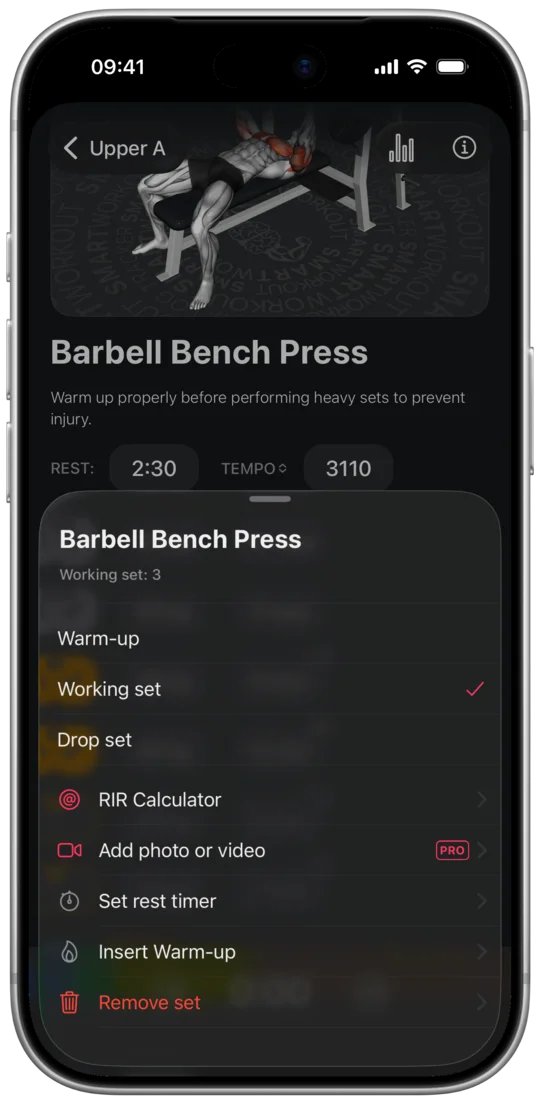
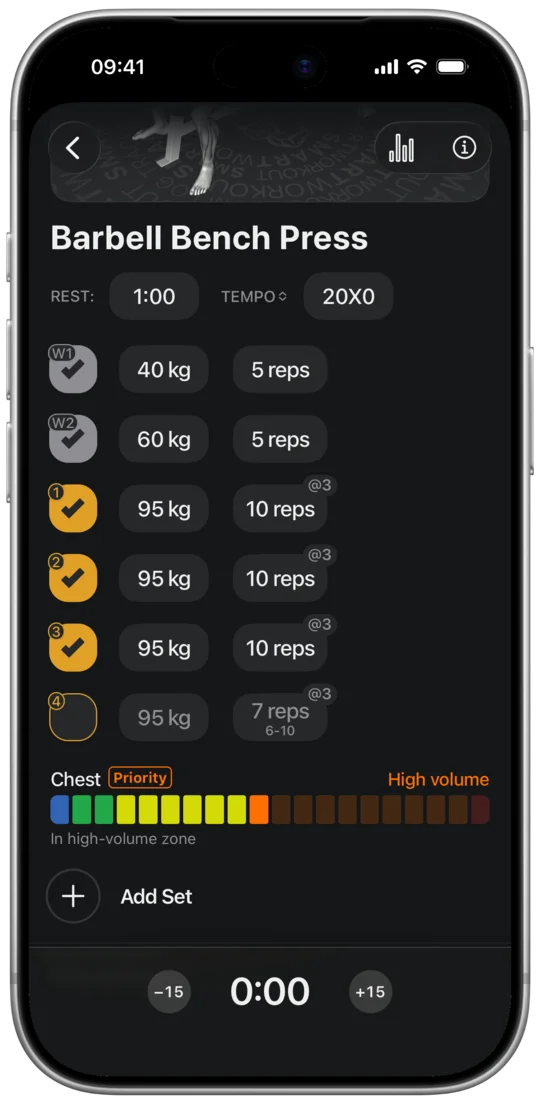
You log a drop set in SmartWorkout as a set of the Drop set type: in the workout log, in templates and in plans.
- In the exercise, tap “Add Set” below your last working set.
- Open the new set's menu and choose “Drop set”. The set gets a “D” label.
- Enter the lower weight and the reps from the drop. A second drop is another Drop set below the first.
- After the last working set, skip the rest timer and go straight into the drop. A Drop set has a 0 s rest, so the timer doesn't start between drops; set the rest before the next exercise on the last drop (“Set rest timer”).
You log a mechanical drop set in one exercise too, e.g. Push-Up, as a working set followed by Drop sets. You can't choose Drop set for an exercise in a group (superset), and adding an exercise to a group turns its drop sets into working sets. You can also pick the Drop set type in the plan creator. The help article on set types and exercise groups explains how set types work.
In weekly sets and volume zones, SmartWorkout counts the whole sequence as 1 set.
With Premium, you see each muscle group's weekly sets against the volume zones while you train.
You can paste this fragment through plan import (Workout > My Plans > “+” > “Import plan”); “+ DROPSET” means drops after the last working set. Import costs 10 AI credits, so the welcome credits cover it.
DAY: Shoulders and arms- Seated Dumbbell Shoulder Press | WU 1x10 | 3x8-10 RIR 2 | TEMPO 2010 | REST 120- Dumbbell Lateral Raise | 3x12-15 RIR 1 + DROPSET 1x6-10 | TEMPO 2010 | REST 90- Machine Preacher Curl | 3x10-12 RIR 1 | TEMPO 2011 | REST 90- Rope Triceps Pushdown | 3x10-12 RIR 1 + DROPSET 2x6-10 | TEMPO 2011 | REST 90Our free plans have no drop sets; add one yourself on the last set of an isolation exercise that isn't in a group.
Log it in SmartWorkout
A free workout log for iPhone and Android: sets, RIR, tempo, exercise groups and plans.


Questions
What does drop set mean?
It's a set where you don't put the weight down at failure: you pick up a lighter one right away and keep going until you run out of reps again. It's also called a strip set or a descending set.
Do drop sets actually work?
They do when you're short on time or when reps on an isolation exercise have stalled for a few sessions. If you still add reps or weight every week, regular sets give you the same result with less fatigue.
Are drop sets better than straight sets for hypertrophy?
Not better, about the same: in a meta-analysis of 12 studies the difference in muscle growth was close to zero. You save time and pay for it with more fatigue.
What is a 10-10-10 drop set?
A drop set with two drops and a target of 10 reps on each of the three weights: 10 reps, drop, 10 more, drop, 10 more. With 20-30% drops you often get fewer than 10 reps on the lighter weights, so start with one drop and aim for 6-10 reps in it.
Should drop sets go to failure?
The drop itself, yes; the working set before it can end at failure or one rep short (RIR 0-1). Do it after the last set of the exercise, where the extra fatigue can't cost reps on sets that follow.
What's the difference between a drop set and a superset?
A drop set is one exercise with a lighter and lighter weight. A superset is two exercises for different muscle groups done back to back, such as biceps and triceps; many guides call any pair a superset, but two exercises for the same muscle group make a compound set.
See also
- Myo-reps: what they are and how to do the activation set and mini setsMyo-reps are a rest-pause method developed by Børge Fagerli: an activation set stopped 1-2 reps short of failure, then 2-5 mini sets of 2-4 reps with the same weight after 3-5 deep breaths (10-15 s). In an 8-week study they built muscle and strength about as well as straight sets, in shorter sessions.
- Rest-pause sets: what they are and how to do themA rest-pause set is a set taken to muscular failure, followed by a 20-30 s pause and more reps with the same weight, usually 1-2 times. In studies it built muscle about as well as straight sets in less time, and in some studies it added slightly more strength.
- How to count sets per muscle group: direct, indirect and warm-up setsCounting sets per muscle group (fractional set counting) means adding up a week's working sets: 1 for the muscle that mainly does the movement, 0.5 for a muscle that clearly assists, 0 for warm-up sets. In a meta-analysis of 67 studies, this matched muscle growth better than counting assisting muscles as 1 or 0.
- Training volume: what it is and what MEV, MAV and MRV meanIn hypertrophy training, training volume is the number of working sets a muscle group gets per week. In a meta-analysis of 67 studies, growth was measurable from about 4 weekly sets, with each extra set adding less; the 2026 ACSM position stand links 10 or more weekly sets to more growth.
- Training to failure: when it helps and when it just adds fatigueTraining to failure means ending a set only when, despite full effort, you cannot complete the next rep through a full range of motion without changing your form. In a meta-analysis of 15 studies it built no significantly more muscle or strength than stopping short of failure, and it is clearly more fatiguing.
- RIR (reps in reserve): what it means and how to estimate itRIR (reps in reserve) is the number of good reps left before failure when a set ends. RIR 0 means no reps left, and RIR 2-3 in a plan means ending the set with 2-3 reps still in the tank. In a meta-analysis of 12 studies, lifters had on average 1 rep more left than they thought.
- Top set and back-off sets: what they are and how much weight to dropA top set is the heaviest working set of an exercise in a session, and back-off sets are 2-4 working sets after it, done after full rest and usually 5-20% lighter. In a 6-week study of powerlifters, 2 back-off sets at 80% of the top set weight gave clearer strength gains than the top set alone.
- Supersets in the gym: what they are, examples and superset vs compound setA superset is two exercises for different muscle groups done back to back with no rest in between; you rest only after both. Two exercises for the same muscle group are usually called a compound set. In a meta-analysis of 19 studies, supersets cut session time by about 37% with similar tonnage.
Sources
- Sødal LK, Kristiansen E, Larsen S, et al. Effects of Drop Sets on Skeletal Muscle Hypertrophy: A Systematic Review and Meta-analysis. Sports Med Open. 2023;9(1):66.
- Havers T, Micke F, Geisler S, et al. Acute and Chronic Effects of Drop-Set Training: A Meta-Analysis and Systematic Review. Sports Med Open. 2026;12(1).
- Coleman M, Harrison K, Arias R, et al. Muscular Adaptations in Drop Set vs. Traditional Training: A meta-analysis. Int J Strength Cond. 2022;2(1).
- Currier BS, D'Souza AC, Singh MAF, et al. American College of Sports Medicine Position Stand. Resistance Training Prescription for Muscle Function, Hypertrophy, and Physical Performance in Healthy Adults: An Overview of Reviews. Med Sci Sports Exerc. 2026;58(4):851-872.
- Iversen VM, Norum M, Schoenfeld BJ, et al. No Time to Lift? Designing Time-Efficient Training Programs for Strength and Hypertrophy: A Narrative Review. Sports Med. 2021;51(10):2079-2095.
- Fink J, Schoenfeld BJ, Kikuchi N, et al. Effects of drop set resistance training on acute stress indicators and long-term muscle hypertrophy and strength. J Sports Med Phys Fitness. 2018;58(5):597-605 (online 2017).
- Ozaki H, Kubota A, Natsume T, et al. Effects of drop sets with resistance training on increases in muscle CSA, strength, and endurance: a pilot study. J Sports Sci. 2018;36(6):691-696 (online 2017).
- Angleri V, Ugrinowitsch C, Libardi CA. Crescent pyramid and drop-set systems do not promote greater strength gains, muscle hypertrophy, and changes on muscle architecture compared with traditional resistance training in well-trained men. Eur J Appl Physiol. 2017;117(2):359-369.
- Varović D, Žganjer K, Vuk S, et al. Drop-Set Training Elicits Differential Increases in Non-Uniform Hypertrophy of the Quadriceps in Leg Extension Exercise. Sports (Basel). 2021;9(9):119.
- Enes A, Alves RC, Schoenfeld BJ, et al. Rest-pause and drop-set training elicit similar strength and hypertrophy adaptations compared with traditional sets in resistance-trained males. Appl Physiol Nutr Metab. 2021;46(11):1417-1424.
- Vargas-Molina S, García-Palumbo A, Petro JL, et al. Comparison of Repetition-Based Progressive-Overload Strategies in Resistance Training: Rest-Pause Versus Drop Sets. Scand J Med Sci Sports. 2026;36(7):e70327.