
AMRAP in numbers
| Parameter | Value | Source |
|---|---|---|
| In a plan | “5+”, “10+”: a minimum with no upper limit; with no RIR in the plan you go to failure (technical failure with a barbell), with a RIR target, e.g. “10+ RIR 2”, you stop with that reserve | Wendler 2016 |
| Reps at 80% of 1RM | barbell bench press about 9, leg press about 13; the spread between people (standard deviation) is about 2.5 reps | meta-regression (Nuzzo et al. 2024) |
| Where and how often | usually the last set of the exercise; with a barbell once a week, with bodyweight and on machines every session | our practice |
- Working set
- Warm-up
What an AMRAP set is for
An AMRAP set is above all a measurement: it tells you whether it's time to add weight. On machines and with bodyweight it's also an ordinary last set to failure that builds muscle like other intensity techniques, but taking every set to failure doesn't bring more strength or more muscle (ACSM 2026).
| Goal | AMRAP? | How and why |
|---|---|---|
| Progression and a 1RM without testing it | yes | the result sets your weight for the next session and gives an estimated 1RM |
| Checking your RIR calls | yes | rate your reserve in a set, then do a set to failure with the same weight to see if your rating was right (Helms et al. 2016) |
| First months of training | not with a barbell, yes on machines | the weight goes up every session anyway (linear progression), so a measurement changes nothing |
| Advanced lifters, heavy barbell lifts | every 2-4 weeks or “5+ RIR 1” | the result swings by 1-2 reps from day to day, so change the weight only when two AMRAP sets in a row point the same way (our practice) |
How to do an AMRAP set
- Pick a weight you can do the minimum with, e.g. 5 on the barbell squat or 10 on the leg press, with 2-3 reps in reserve.
- Do the AMRAP with your working-set weight as the last set of the exercise. Do it as the first set when you want to use its result to estimate your 1RM or set the weight of your back-off sets; you can work out that weight in the 1RM calculator.
- Set the safety arms a few centimeters below the bottom of your squat; for the bench press, set them so the bar rests on them when you flatten your arched back. Or ask for a spot.
- On the barbell squat and barbell bench press, stop at technical failure: in the squat when your hips rise faster than your shoulders, in the bench press when the bar drifts off its path or your glutes leave the bench.
- On machines, cables and bodyweight exercises, keep going until the next rep won't go through the full range of motion without swinging.
- Log the reps and RIR 0 after muscular or technical failure. If you stop because a rep only slowed down a lot, log RIR 1.
The thresholds below are our practice, modeled on the APRE method (Zhang et al. 2021).
| Result of an “N+” set | Next session |
|---|---|
| below N | cut the weight by 5-10%, unless it's the first session after moving the pin on a machine one plate up; that's a big jump (5 kg at 40 kg is 12.5%) |
| N to N+2 | keep the weight |
| N+3 to N+5 | add 2.5 kg on the bench press, 5 kg on the squat and deadlift, 5-10 kg on the leg press; on a pin-loaded machine, move the pin one plate up only at N+5 |
| N+6 or more | the weight was too light: work out a new one from your estimated 1RM in the 1RM calculator |
How to estimate your 1RM from an AMRAP set
An AMRAP set gives you an estimated 1RM: 80 kg × 8 on the barbell bench press comes out at about 100 kg in the 1RM calculator. Formulas are most accurate for sets of up to 10 reps (Reynolds et al. 2006), and on the leg press they overestimate 1RM by 10-15%. For a set with reps in reserve, use the RIR and RPE mode.
AMRAP set examples in kg
| Exercise | Working sets | AMRAP set and result | Next session |
|---|---|---|---|
| Barbell Squat | 2 × 5, 100 kg, RIR 3 | 1 × 5+, 100 kg: 8 (estimated 1RM at least 125 kg) | 105 kg |
| Leg Press | 2 × 10, 140 kg, RIR 2 | 1 × 10+, 140 kg: 11 | 140 kg |
| Pull-Up | 2 × 5, RIR 2 | 1 × 5+: 9 | 2.5 kg on a dip belt |
AMRAP with bodyweight, machines and barbells
AMRAP sets to failure are safest with bodyweight and on machines, where you need no spotter.
| Good fit | Why |
|---|---|
| Pull-Up | if you can't do 5 reps, do a 10+ set on the Assisted Pull-Up instead |
| Seated Leg Extension Machine | you can lower the stack at any moment |
| Leg Press | only with the safety stops set; stop when your pelvis lifts off the back pad |
| Push-Up | a max-rep test with no equipment |
| Not to muscular failure | Why |
|---|---|
| Deadlift | your back loses its position before failure; stop 1-2 reps short and log that RIR |
| Barbell Overhead Press | as you tire, you lean back and arch your lower back; stop there |
AMRAP vs EMOM vs rest-pause
In an AMRAP set you fix the weight in advance, in an AMRAP workout the length of the workout, in EMOM the reps per minute, and in rest-pause the weight and the short pauses.
| Format | What it's for |
|---|---|
| AMRAP (set) | measurement, progression, 1RM |
| AMRAP workout | conditioning, like circuit training |
| EMOM | technique and steady work |
With a barbell, an AMRAP on a lighter back-off set is often the safer choice, e.g. 80 kg × 10+ after 100 kg × 5.
AMRAP workouts in CrossFit
In CrossFit, AMRAP is a timed workout: as many rounds as possible in a set time, e.g. 5 pull-ups, 10 push-ups and 15 squats on repeat for 20 minutes (CrossFit 2024).
EMOM: what it is and how it differs from AMRAP
EMOM (every minute on the minute) is a format in which you do a set number of reps at the start of every minute and rest for the rest of that minute (CrossFit 2024). An EMOM 10 on the barbell squat is, for example, 3 reps every minute with a weight you could lift 10-12 times, 30 reps in total.
In 25 functional fitness athletes, EMOM was the least fatiguing of three timed formats: it produced the least lactate and, unlike AMRAP, didn't lower jump height (Oliver-López et al. 2025).
Common mistakes
- AMRAP on every set. After sets to failure, recovery takes longer, up to 24-48 h (Morán-Navarro et al. 2017), and strength doesn't go up any faster. Do one AMRAP set per exercise.
- Stopping at the minimum. A “10+” set stopped at 10 when more reps were there measures nothing. Go to failure or to your planned reserve.
- Partial reps. A pull-up without your chin over the bar or a bar bounced off your chest inflates the result. Count only full reps.
- Different conditions every week. A result isn't comparable when the rest was shorter or the exercise came at a different point in the workout (e.g. at the end instead of the start); keep the same exercise order and the same rest.
What the research says
Research on AMRAP sets covers how many reps people do at a given %1RM and the APRE method.
| Claim | What studies show | Certainty |
|---|---|---|
| “AMRAP sets steer progression well” | autoregulation (setting the weight from the day's results), including APRE with sets to failure, built more strength than a fixed weight | low |
| Study | Type and sample | Result | Limitation |
|---|---|---|---|
| Nuzzo et al. 2024 | meta-regression, 269 studies, 7,289 people | reps as in the table at the top; sex, age and training status had almost no effect | mostly bench press and leg press |
| Zhang et al. 2021 | meta-analysis, 8 studies, 166 athletes | as in the claims table | athletes only |
It's unknown whether one AMRAP set at the end of an exercise gives more in the long run than the same plan without it: the APRE studies lasted only 5-10 weeks.
How to log an AMRAP set in SmartWorkout
In SmartWorkout you set up an AMRAP set in a plan or template as a set with only a minimum number of reps; there's no separate set type for it.
- In the plan creator or in a template, tap the reps column header and choose “Repetition range” under “Repetition options”.
- Enter the minimum in the “min” field, e.g. 10, and leave the “AMRAP” field empty.
- During the workout this set has a target of “10 - ∞”. Enter the reps you actually did, because approving an empty set logs just the minimum.
- On the keyboard, pick RIR 0 or, on the RPE scale, RPE 10.
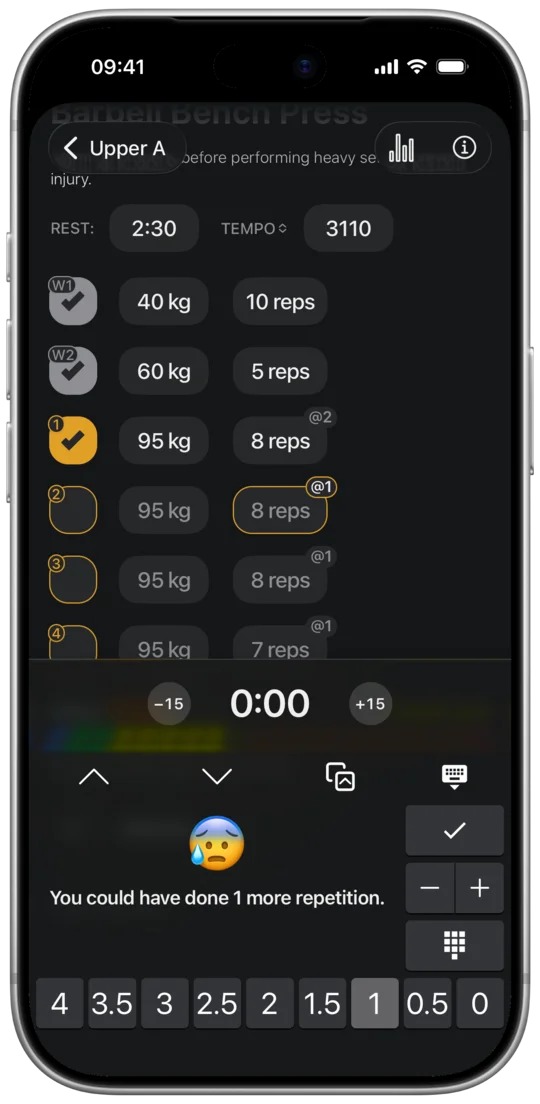
Our free full body to split plan has “12+” sets in the reverse crunches and machine abdominal crunches.
You can paste this fragment through plan import (Workout > My Plans > “+” > “Import plan”). Import costs 10 AI credits, so the welcome credits cover it.
DAY: Lower A- Barbell Squat | WU 2x5 | 2x5 RIR 3 + 1x5+ | TEMPO 20X0 | REST 180- Leg Press | 2x10 RIR 2 + 1x10+ RIR 0 | TEMPO 2010 | REST 150- Seated Leg Curl | 3x10-12 RIR 1 | TEMPO 2011 | REST 90- Machine Abdominal Crunches | 1x12+ RIR 1 + 1x12+ RIR 0 | TEMPO 2011 | REST 60Log it in SmartWorkout
A free workout log for iPhone and Android: sets, RIR, tempo, exercise groups and plans.


Questions
What is an AMRAP set?
An AMRAP set (as many reps as possible) is a set in which you do as many clean reps as you can with a given weight. In CrossFit the same abbreviation means a timed workout: as many rounds as possible in a set time, e.g. 20 minutes.
Is AMRAP till failure?
When the plan gives no reps in reserve, yes: to muscular failure (RIR 0) on machines and with bodyweight, to technical failure on the barbell squat and barbell bench press. On the deadlift you stop once you beat your rep record, before reaching failure, as in the record sets of 5/3/1; there are usually 1-2 reps left, so log RIR 1 or 2. When the plan includes a reserve, e.g. “10+ RIR 2”, you stop with that reserve.
Is AMRAP better than EMOM?
As a timed workout, AMRAP is more tiring, because the rounds run with no fixed rest until time is up; it's conditioning work. EMOM gives you a break every minute and less fatigue, so it suits technique and heavier reps better.
What does EMOM 10 mean?
It's 10 minutes in which you do a set number of reps at the start of every minute. The faster you finish them, the longer you rest before the next minute.
What is a 20-minute AMRAP workout?
It's a timed workout: what counts is how many rounds of a fixed group of exercises you complete in 20 minutes, and you take rests when you need them. Pace yourself so each round takes about the same time. Split pull-ups you can't do in one go into sets of 2 and 3, or do them on the assisted pull-up machine.
See also
- Training to failure: when it helps and when it just adds fatigueTraining to failure means ending a set only when, despite full effort, you cannot complete the next rep through a full range of motion without changing your form. In a meta-analysis of 15 studies it built no significantly more muscle or strength than stopping short of failure, and it is clearly more fatiguing.
- RIR (reps in reserve): what it means and how to estimate itRIR (reps in reserve) is the number of good reps left before failure when a set ends. RIR 0 means no reps left, and RIR 2-3 in a plan means ending the set with 2-3 reps still in the tank. In a meta-analysis of 12 studies, lifters had on average 1 rep more left than they thought.
- Rep ranges: how many reps for hypertrophy, strength and cuttingA rep range is the span of reps, such as 8-12, in which a set with a given weight should end. For muscle growth the exact number matters little: in studies, muscle grew similarly with sets of about 5 to more than 30 reps close to failure, while strength grew most with loads of 80% of 1RM or more.
- Progressive overload: what it is, linear vs double progression, and how to break a plateauProgressive overload is the gradual increase of training demands, most often load, reps or sets. The ACSM advises adding 2-10% load once you do 1-2 reps over your target in two sessions in a row. In an 8-week study, adding reps built about as much muscle as adding load.
- Top set and back-off sets: what they are and how much weight to dropA top set is the heaviest working set of an exercise in a session, and back-off sets are 2-4 working sets after it, done after full rest and usually 5-20% lighter. In a 6-week study of powerlifters, 2 back-off sets at 80% of the top set weight gave clearer strength gains than the top set alone.
- Rest-pause sets: what they are and how to do themA rest-pause set is a set taken to muscular failure, followed by a 20-30 s pause and more reps with the same weight, usually 1-2 times. In studies it built muscle about as well as straight sets in less time, and in some studies it added slightly more strength.
- Circuit training for strength: how to build a gym circuitCircuit training (a circuit) is 3 or more exercises, not all for the same muscle group, done one after another in rounds with a short move between stations. In two 8-week studies in trained lifters, circuits with sets close to failure built strength and lean mass about as well as straight sets, in less time.
Sources
- CrossFit. CrossFit Terms Explained. CrossFit.com. 10.04.2024.
- Wendler J. 5/3/1 for Hardgainers. JimWendler.com. 2016.
- Wendler J. 5/3/1 Beach Body (Performance Based) Challenge. JimWendler.com. 2018.
- Nuzzo JL, Pinto MD, Nosaka K, et al. Maximal Number of Repetitions at Percentages of the One Repetition Maximum: A Meta-Regression and Moderator Analysis of Sex, Age, Training Status, and Exercise. Sports Med. 2024;54(2):303-321 (online 2023).
- Reynolds JM, Gordon TJ, Robergs RA. Prediction of one repetition maximum strength from multiple repetition maximum testing and anthropometry. J Strength Cond Res. 2006;20(3):584-92.
- Currier BS, D'Souza AC, Singh MAF, et al. American College of Sports Medicine Position Stand. Resistance Training Prescription for Muscle Function, Hypertrophy, and Physical Performance in Healthy Adults: An Overview of Reviews. Med Sci Sports Exerc. 2026;58(4):851-872.
- Helms ER, Cronin J, Storey A, et al. Application of the Repetitions in Reserve-Based Rating of Perceived Exertion Scale for Resistance Training. Strength Cond J. 2016;38(4):42-49.
- MacDougall JD, Tuxen D, Sale DG, et al. Arterial blood pressure response to heavy resistance exercise. J Appl Physiol (1985). 1985;58(3):785-90.
- Zhang X, Li H, Bi S, et al. Auto-Regulation Method vs. Fixed-Loading Method in Maximum Strength Training for Athletes: A Systematic Review and Meta-Analysis. Front Physiol. 2021;12:651112.
- Oliver-López A, García-Valverde A, Sabido R. Acute effect of three functional fitness training designs with equalized load on inexperienced and experienced athletes. PeerJ. 2025;13:e19265.