3-day full body workout plan for women
Three full-body gym sessions a week for 8 weeks, for beginners, with glutes and legs trained first in every session and given the most sets.
This is the 3-day full body plan with glute and leg priority. Every session opens with the lower body while you are fresh, and each day leads with a different movement: the squat and the machine hip thrust on Monday, the dumbbell Romanian deadlift on Wednesday, the hip thrust again on Friday, with the seated leg curl every day and the leg extension on Wednesday and Friday. The glutes get 12 sets a week instead of the standard plan's 8.5, half of them from the hip thrust, the hamstrings 10 and the quads 9. The upper body follows with two or three exercises a session, mostly back and shoulders, 4-6 sets a week per muscle: enough to keep growing. Strength training works the same for women and men, so the plan suits anyone who wants glutes and legs first.
| Split | Days a week | Level | Weeks | Minutes | Sets a week | Equipment | In the app |
|---|---|---|---|---|---|---|---|
| Full body | 3 | Beginner | 8 | ≈35–45 | 42 | Barbell, Machines, Dumbbells | Full body · 3 days · Glutes |
Track this plan for free in SmartWorkout
The same exercises, sets, reps and RIR, ready in the app. Logging, rest timer and history are free. Automatic progression suggestions: Premium.
In the app: Plans → Full body · 3 days · Glutes


Good fit if
- Your glutes and legs come first, and you want the upper body to keep up rather than lead.
- You are new to the gym or coming back after a long break.
- You can train three times a week, about 35-45 minutes each time.
- You would rather learn on machines and dumbbells, with the squat as the only barbell lift.
Take another plan if
- You want the whole body trained evenly: take the standard 3-day full body plan.
- Your weights go up only every week or two: take the 4-day upper/lower plan with glute and leg priority, built for intermediates.
Weekly schedule
| Mon | Tue | Wed | Thu | Fri | Sat | Sun |
|---|---|---|---|---|---|---|
| Full Body A | Rest | Full Body B | Rest | Full Body C | Rest | Rest |
Missed a day? Do the next session in order: the app runs the sessions in sequence.
Keep a rest day between sessions if you can: all three train the glutes and legs. If two sessions have to fall on consecutive days, make it A and B, which share only the leg curl.
The plan, week 1
Week 1 is calibration: pick a weight for the bottom of each range with one more rep in reserve than later. The RIR column shows week 1 → week 2 onwards; the grid below shows what changes in weeks 2-8.
Tempo 3-0-1-0: 3 s lowering, 0 s pause in the stretch, 1 s lifting, 0 s pause in the squeeze. X: lift as fast as you can while staying in control.
What RIR means →How to read tempo →
| Exercise | Sets × reps | RIR | Tempo | Rest | Notes |
|---|---|---|---|---|---|
| WUWarm-up sets | 2 × 5 | – | – | 1:00 | |
A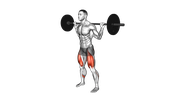 Barbell Squat | 3 × 6–10 | 3 → 2 | 3-0-1-0 | 2:30 | The plan's only barbell lift. Not ready for the bar yet? Take the dumbbell sumo squat instead and keep it for all 8 weeks. |
B Machine Hip Thrust | 3 × 8–12 | 3 → 2 | 2-0-1-1 | 2:00 | Upper back against the pad, chin tucked; push through your heels and hold the top of every rep for a second, squeezing your glutes. |
C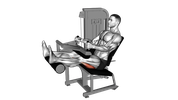 Seated Leg Curl | 2 × 10–15 | 3 → 2 | 3-0-1-1 | 1:30 | |
D Dumbbell Bench Press | 2 × 8–12 | 3 → 2 | 3-0-1-0 | 2:00 | |
E Cable Lat Pulldown | 3 × 8–12 | 3 → 2 | 3-0-1-1 | 2:00 | |
F Dumbbell Lateral Raise | 2 × 12–20 | 3 → 2 | 2-0-1-1 | 1:00 |
15 working sets · ≈45 min
| Exercise | Sets × reps | RIR | Tempo | Rest | Notes |
|---|---|---|---|---|---|
| WUWarm-up sets | 2 × 8 | – | – | 1:00 | |
A Dumbbell Romanian Deadlift | 3 × 8–12 | 3 → 2 | 3-1-1-0 | 2:00 | Hips back, knees soft, dumbbells close to your legs; lower until you feel a stretch in your hamstrings and stop before your back rounds. |
| BSeated Leg Curl | 2 × 10–15 | 3 → 2 | 3-0-1-1 | 1:30 | |
C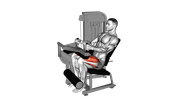 Seated Leg Extension Machine | 3 × 10–15 | 3 → 2 | 3-0-1-1 | 1:30 | Pad just above your ankles; pause for a moment at the top and lower slowly, three seconds down. |
D Seated Dumbbell Shoulder Press | 2 × 8–12 | 3 → 2 | 3-0-1-0 | 2:00 | |
E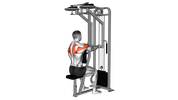 Machine Reverse Flyes | 3 × 12–20 | 3 → 2 | 2-0-1-1 | 1:00 |
13 working sets · ≈35 min
| Exercise | Sets × reps | RIR | Tempo | Rest | Notes |
|---|---|---|---|---|---|
| WUWarm-up sets | 2 × 8 | – | – | 1:00 | |
| AMachine Hip Thrust | 3 × 8–12 | 3 → 2 | 2-0-1-1 | 2:00 | Upper back against the pad, chin tucked; push through your heels and hold the top of every rep for a second, squeezing your glutes. |
| BSeated Leg Extension Machine | 3 × 10–15 | 3 → 2 | 3-0-1-1 | 1:30 | Pad just above your ankles; pause for a moment at the top and lower slowly, three seconds down. |
| CSeated Leg Curl | 3 × 10–15 | 3 → 2 | 3-0-1-1 | 1:30 | |
D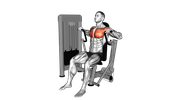 Machine Chest Press | 2 × 8–12 | 3 → 2 | 3-0-1-0 | 2:00 | |
E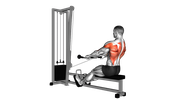 Seated Cable Row | 3 × 8–12 | 3 → 2 | 3-0-1-1 | 2:00 |
14 working sets · ≈40 min
Track this plan for free
Week by week
| W1 | W2 | W3 | W4 | W5 | W6 | W7 | W8 | |
|---|---|---|---|---|---|---|---|---|
| Phase | Calibration | Build | Build | Build | Build | Build | Build | Build |
| RIR | 3 | 2 | 2 | 2 | 2 | 2 | 2 | 2 |
| Working sets | 42 | 42 | 42 | 42 | 42 | 42 | 42 | 42 |
| What to do | Find your weights | Reps, then weight | Reps, then weight | Reps, then weight | Reps, then weight | Reps, then weight | Reps, then weight | Reps, then weight |
| Done: Full Body A | ||||||||
| Done: Full Body B | ||||||||
| Done: Full Body C |
No planned deload: beginners recover between sessions at this volume. If two sessions in a row go backwards, take an easy week.
Saved only in this browser. The app keeps your weights and reps.
Worked example: Dumbbell Romanian Deadlift
Sample numbers of a simulated lifter, worked through with the manual rule on this page.
| Week | Weight | Reps per set | RIR | Next session |
|---|---|---|---|---|
| 1 | 16 kg | 8 · 8 · 8 | 3 | Calibration done: add reps |
| 2 | 16 kg | 9 · 9 · 9 | 3 | Add reps |
| 3 | 16 kg | 10 · 10 · 10 | 2 | Add reps |
| 4 | 16 kg | 11 · 11 · 11 | 2 | Add reps |
| 5 | 16 kg | 12 · 12 · 11 | 2 | Last sets catch up |
| 6 | 16 kg | 12 · 12 · 12 | 2 | All sets at the top: 18 kg |
| 7 | 18 kg | 9 · 9 · 9 | 3 | Add reps |
| 8 | 18 kg | 10 · 10 · 10 | 2 | Next run starts at 18 kg |
How to progress on this plan
The simplest method that works on any plan: double progression. Keep the weight and add reps while you finish your sets with the reserve in the RIR column. When every set reaches the top of the range, add one step and build the reps up again.
- Barbell Squat 3 × 6–10 at RIR 2: when all 3 sets reach 10 reps at RIR 2 or easier, add 2.5 kg next session.
- Machine Hip Thrust 3 × 8–12 at RIR 2: when all 3 sets reach 12 reps at RIR 2 or easier, add 2.5 kg next session.
- Dumbbell Bench Press 2 × 8–12 at RIR 2: when both sets reach 12 reps at RIR 2 or easier, add 2 kg next session.
- Cable Lat Pulldown 3 × 8–12 at RIR 2: when all 3 sets reach 12 reps at RIR 2 or easier, add 2.5 kg next session.
- Dumbbell Romanian Deadlift 3 × 8–12 at RIR 2: when all 3 sets reach 12 reps at RIR 2 or easier, add 2 kg next session.
- Seated Dumbbell Shoulder Press 2 × 8–12 at RIR 2: when both sets reach 12 reps at RIR 2 or easier, add 2 kg next session.
- Isolation exercises (10–20 reps) follow the same rule. With light dumbbells, the next pair can be too big a jump: use the in-between weight, or stay and go 1-2 reps above the range for a week or two.
- The machine hip thrust is the plan's main lift and comes twice a week with the same 3 × 8-12: on Monday after the squat, on Friday as the first exercise. Each session builds on the last one, whichever day it was: 10, 10 and 9 reps on Monday means aiming for 10, 10 and 10 on Friday. That is two chances a week to add a rep.
- The seated leg curl comes on all three days: Monday and Wednesday have the same 2 × 10-15, so Wednesday builds on Monday, while Friday's 3 × 10-15 builds on last Friday. The leg extension keeps the same 3 × 10-15 on Wednesday and Friday, so each session builds on the one before.
- After week 8, run the plan again with week 1 as calibration: enter a week-8 set in the starting-weights calculator below and pick your week-1 weights from it.
What to do next session
| You logged | Next session |
|---|---|
| All sets at the top of the range with the planned reserve | One weight step up |
| Below the top, with the planned reserve | Same weight, +1 rep on the sets that allow it |
| One rep less in reserve than planned | Same weight and reps: repeat the session |
| Sets below the range, or RIR 0 when the target was 2 | Keep the weight; if sets fell below the range, one step down |
| No progress for 2 sessions | Check rest and honest RIR; after a 3rd session, about −10% and build back up |
Your starting weights
Enter a recent set of the exercise: weight, reps and how many reps you had left. You get the week-1 weight for the bottom of the range with one rep more in reserve, from the widely used RPE chart (RTS).
Weekly volume per muscle
Working sets per muscle in a regular week, counted the way the app counts them: a set is 1 for a muscle the exercise trains directly and 0.5 for one it trains indirectly. Warm-ups don't count.
- Chest4 · 2×/wk
- Back6 · 2×/wk
- Quadriceps9 · 3×/wk
- Hamstrings10 · 3×/wk
- Gluteus12 · 3×/wk
- Side delts5.5 · 2×/wk
- Rear delts4.5 · 1×/wk
- Biceps–
- Triceps3 · 1×/wk
- Front delts5 · 1×/wk
- Calves–
- Abs–
- Trapezius6 · 1×/wk
- Lower Back3 · 1×/wk
Abs and calves are optional. From 10 sets a week the app labels a muscle "High volume": above its default target and still productive.
Substitutions
Choose your substitute in week 1 and keep it for all 8 weeks: the app tracks progress per exercise. Each substitute trains the same muscles directly, so the volume above stays the same.
Adapt the plan
- Short on time
- Cut from the end, not the start: skip the lateral raise on Monday (about 4 minutes) or the reverse flyes on Wednesday (about 6 minutes). On a really short day, do the leg exercises at the start and one upper-body exercise after them, then stop. Don't skip the same exercise every week.
- Bulking or cutting
- Keep the plan as it is in both. On a cut, aim to hold your weights: reps that drop by one or two are normal, and you can skip the last set of the isolation exercises if recovery suffers.
- Bringing up one muscle
- Glutes and legs already have priority here. To bring up one upper-body muscle, add 2 sets for it on a day that already trains it (about 4 minutes). If your whole upper body matters as much as your legs, the standard 3-day full body plan is the better fit.
- Over 40
- Warm up a little longer, keep one more rep in reserve on the heavy barbell lifts and take the full rest. Joints decide the pace, not the calendar.
- Training at home
- This plan is built on gym machines. At home with dumbbells and an adjustable bench, take the 3-day dumbbell full body plan and add 2 sets of dumbbell hip thrusts at the end of its day B for the glutes.
The same plan in the app
The app opens exactly this plan: all 8 weeks, the same targets, week 1 calibration included. Its description in the app:
A beginner full body (FBW) plan with glute and leg priority: three workouts a week (Mon, Wed, Fri), mostly on machines and dumbbells with the barbell squat. Glutes get about 12 sets a week, half of them from the machine hip thrust, quads and hamstrings 9-10 (squat, Romanian deadlift, leg extension, leg curl), the upper body fewer, mostly back and shoulders. 8 weeks: week 1 is calibration (pick weights that leave 3 reps in reserve, RIR 3), weeks 2-8 at RIR 2. Progression: add reps first, then weight once every set reaches the top of its range at the target RIR.
Free: the plan, logging weight, reps and RIR, the rest timer, history, previous results and the calculators.
This page teaches the manual method. With Premium, the app suggests the weight and reps for every set after each workout, from the weights, reps and RIR you logged, including week-1 calibration and the deload. Its suggestions can differ from this simple rule because it uses more of your data.
Track this plan for free in SmartWorkout
The same exercises, sets, reps and RIR, ready in the app. Logging, rest timer and history are free. Automatic progression suggestions: Premium.
In the app: Plans → Full body · 3 days · Glutes