HRV at a glance
HRV is heart rate variability: how much the intervals between consecutive heartbeats differ from one another. A watch shows it in milliseconds (ms), and the number only means something next to your own normal.
| Parameter | Value | Source |
|---|---|---|
| Unit | Milliseconds. RMSSD mainly reflects the vagus nerve, which slows the heart at rest. | Shaffer and Ginsberg 2017 |
| Metric in your watch | Apple Watch shows SDNN from short readings across the day. Health Connect on Android shows RMSSD. | Apple 2024, Android Developers |
| Differences between people | People can differ several times over, even healthy people of the same age. | Nunan et al. 2010 |
| Day-to-day swings | Readings swing 10-20% in training athletes. | Buchheit 2014 |
| When to look for a cause | When the value is clearly below your range for several days in a row, especially with a higher resting heart rate. | our practice |
What HRV is and how a watch measures it
Heart rate variability (HRV) is the variation in time between consecutive heartbeats (Shaffer and Ginsberg 2017). At 60 beats per minute, one interval can last 0.96 s and the next 1.04 s. Much of this is driven by the vagus nerve, which slows the heart at rest, so HRV goes up when you are calm and asleep and goes down with stress, exercise and illness.
A watch measures HRV with an optical sensor on the wrist, and only while your arm is still (Apple 2024); research on athletes mostly uses a chest strap.
Apple Watch SDNN vs Health Connect RMSSD
Apple Watch calculates HRV as SDNN from readings taken in the background (Apple 2024), each lasting about a minute (Hirten et al. 2021). On Android, Health Connect has a single record type for HRV: RMSSD (Android Developers), so HRV from any watch or ring lands there in that form.
| SDNN | RMSSD | |
|---|---|---|
| What it calculates | the spread of all intervals in a reading | the differences between consecutive intervals |
| What it reflects | both branches of the nervous system at once | mainly the vagus nerve |
| Where you see it | Apple Watch, Apple Health | Health Connect, most sports research |
Norms from recordings of different lengths are not interchangeable (Shaffer and Ginsberg 2017), and compared with a chest strap, Apple Watch underestimated HRV by 8 ms on average while measuring resting heart rate accurately (O'Grady et al. 2024). So compare your watch only with itself; after you switch devices, your normal starts over.
Normal HRV: why comparing with other people says little
A normal HRV by age chart tells you little about your own number, because healthy people differ from each other more than training changes them.
| Factor | What the research shows |
|---|---|
| Genes | In a study of twins and siblings, genes explained 40-48% of the differences in RMSSD (Kupper et al. 2004). |
| Age | RMSSD falls with age, to about 47% of its youthful value by the sixth decade (Umetani et al. 1998). The drop also shows in 8 million wearable users (Natarajan et al. 2020). |
| Method and time of day | HRV has a strong daily rhythm (Natarajan et al. 2020). That's why night, morning and daytime readings give different numbers. |
| Fitness | Training, mostly endurance, raises HRV moderately (Sandercock et al. 2005). In healthy people, strength training does not change it, or barely does (Bhati et al. 2019). |
For example, someone who lifts 4 times a week usually sits at 30 ms, while a less active friend sits at 50 ms. That does not mean the friend is better rested or healthier: both numbers can be normal for those two people, and readings from two different watches are not comparable anyway.
When low HRV means something
One day with HRV 10-20% lower is often just normal variation; the signal is a value clearly below your usual range or several low days in a row. In athletes, swings like that from day to day are common, and only an average of at least 3-4 days was linked to performance (Buchheit 2014). A high HRV is not a green light either: in elite athletes, both drops and rises in HRV came before poorer adaptation (Plews et al. 2013).
| What you see | What to do |
|---|---|
| One lower day, sleep and how you feel unchanged | Train as planned. |
| HRV clearly below your range, or a short night | Train as planned and check how your warm-up goes. If it feels clearly heavier than usual, leave 1-2 more reps in reserve on your sets. |
| Two weak signals at once, e.g. low HRV and a higher resting heart rate | Do the same check. If your first sets feel heavier, do one set fewer per exercise and leave 2-3 reps in reserve. |
| Several low days in a row with no clear cause | Check your sleep, food and stress. If your lifts drop too, consider a deload. |
| Higher resting heart rate with a fever, sore throat or feeling run down | Skip hard training until the symptoms are gone. |
| HRV lower for several weeks for no reason, palpitations, shortness of breath, dizziness | See a doctor. |
What lowers HRV on a rest day
HRV does not drop only after training, so after a weekend away from the gym it is often lower than midweek. Say someone usually sits at 33 ms; after a late heavy dinner and several glasses of cola, the watch shows 28 ms, which is 15% lower: still ordinary variation, and together with a shorter night a reason to pay closer attention to the warm-up.
| Cause | What the research shows | What to do |
|---|---|---|
| Alcohol | The drop grows with the dose and appears even after a small one. After a large dose (for someone weighing 80 kg, from about three half-liter beers) RMSSD in the first hours of sleep was 13 ms lower and heart rate 9 beats per minute higher (Pietilä et al. 2018). | The next day, judge your strength in the warm-up before the heavy sets. |
| A late, heavy meal | A large dinner lowered vagal activity during the night in young women (Tada et al. 2018). In men, a meal at 10 p.m. did not change morning HRV but did disturb sleep (Uçar et al. 2021). | Eat your biggest meal a few hours before bed. |
| Caffeine and sugary drinks | Caffeine alone did not change HRV after exercise (Almeida et al. 2024), but taken even 6 h before bed it disturbed sleep (Drake et al. 2013). 500 ml of a sugar-sweetened soft drink lowered RMSSD within half an hour (Chapman et al. 2021). | Have your last coffee or cola at least 6 h before bed. |
| Short, late or irregular sleep | Sleep deprivation lowered RMSSD, while SDNN did not change clearly (Zhang et al. 2025). Irregular sleep timing was linked to worse heart health, though those studies did not measure HRV (Kalkanis et al. 2025). | On weekends, go to bed no more than an hour later than on weekdays. |
| Heat | HRV was lower at 35 °C than at 19 °C (Abellán-Aynés et al. 2021). | Compare days at a similar temperature. |
| Dehydration | Losing about 0.6% of body weight in the heat was linked to lower HRV (Young et al. 2019). HRV rose after drinking water (Christiani et al. 2021). | Drink regularly, especially in hot weather. |
| The start of an illness | The daily rhythm of Apple Watch SDNN changed in the week before and after a COVID-19 diagnosis (Hirten et al. 2021). At the onset of infection, resting heart rate rose by a median of 7 beats per minute (Mishra et al. 2020). | When your heart rate is higher and you feel unwell, skip hard training. |
| A hard workout 1-2 days before | In weightlifters, HRV was back to baseline after 24 h, while muscle soreness lasted 72 h (Chen et al. 2011). After a hard endurance session, recovery took at least 48 h (Stanley et al. 2013). | This is a normal effect of training. |
| Stress | In a review of 37 publications, stress most often lowered vagal activity (Kim et al. 2018). | Judge your strength in the warm-up. |
How to train on a low HRV day
On a low HRV day the morning reading only flags the day; your warm-up and first working set decide the effort. The plan for the week stays the same.
- In the morning, check last night's or this morning's value and compare it with your range over the last 4 weeks, on the same watch.
- When HRV is clearly lower or the night was short, start as planned and judge your last warm-up set and first working set: if the weight moves as usual and your RIR matches the plan, carry on unchanged.
- If it feels clearly heavier, finish the following sets with 1-2 more reps in reserve, aiming for RIR 2-3 instead of RIR 1-2, and don't take any set to muscular failure.
- When several signals are low at once and your first sets also feel heavier, do one set fewer per exercise and leave 2-3 reps in reserve.
- Add the skipped set to the next session for that muscle group in the same week.
- Keep the weight from your plan; drop it by 5-10% only if your last warm-up set already feels clearly heavier than usual.
No study of a strength plan guided by HRV exists yet, so your first sets are the better guide for today. When they feel heavier, reps in reserve are the simplest way to make the day easier: sets taken to failure stretch recovery to 24-48 h (Morán-Navarro et al. 2017), and doing half the possible reps with the same weight is clearly less fatiguing than a set taken all the way (Pareja-Blanco et al. 2017). Together with the load, reps in reserve make up training intensity. Sleep loss cut exercise performance by about 8% on average (Craven et al. 2022), and several short nights in a row reduced strength in compound lifts (Knowles et al. 2018).
A weaker day in kg
Here is the same workout on a normal day and on a day when the warm-up felt clearly heavier: with more reps in reserve or, with several weak signals at once, with one set fewer.
| Exercise | Normal day | Lighter day | Clearly bad day |
|---|---|---|---|
| Barbell Squat | 100 kg, 3 × 6, RIR 2 | 100 kg, 3 × 5, RIR 3 | 100 kg, 2 × 5, RIR 3 |
| Barbell Bench Press | 80 kg, 3 × 8, RIR 2 | 80 kg, 3 × 7, RIR 3 | 80 kg, 2 × 7, RIR 3 |
| Barbell Bent Over Row | 70 kg, 3 × 8, RIR 2 | 70 kg, 3 × 7, RIR 3 | 70 kg, 2 × 7, RIR 3 |
| Seated Leg Extension Machine | 50 kg, 3 × 12, RIR 1 | 50 kg, 3 × 11, RIR 2 | 50 kg, 2 × 10, RIR 3 |
You lose as many reps as you add to your reserve: 6 reps at RIR 2 means you could do at most 8 with that weight, so at RIR 3 you stop at 5. A lighter weight for the same reps is easy to work out in the RIR/RPE calculator.
Training volume counts over the week, so one weaker day does not undo it. With two leg sessions a week, the skipped squat set goes into the second one as 4 sets instead of 3, and the week ends with the same number of sets. You can count the weekly sets for each muscle group in the weekly volume calculator.
HRV vs resting heart rate, sleep and soreness
HRV, resting heart rate and sleep each say something different about readiness to train, and they mean the most together.
| Signal | What it tells you | Where it fails |
|---|---|---|
| HRV | It shows how far the nervous system has shifted into rest mode. | It swings a lot from day to day, and different devices show different metrics. |
| Resting heart rate | It rises after alcohol and at the start of an infection. With fatigue and a lower HRV it usually goes up too (Buchheit 2014). | The watch is off by about 4 beats per minute on average (O'Grady et al. 2024), so a single day says little. |
| Sleep duration | Under 7 h, adults sleep less than sleep medicine societies recommend (Watson et al. 2015). | The watch measures how long you slept, not how restorative it was. |
| Muscle soreness | It shows fatigue of a specific muscle group. | It doesn't match HRV. HRV recovers within a day, while soreness lasts up to 3 days (Chen et al. 2011). |
So HRV does not tell you whether your muscles have recovered; your lifts decide when to train the same muscle group hard again, as described under supercompensation.
Common HRV mistakes
- Comparing with others. Your 30 ms next to someone's 50 ms says nothing about recovery; compare today with your own last few weeks.
- New watch, old normal. Another device calculates HRV differently and at other times; after switching, wait a few weeks before comparing.
- Reacting to one morning. Daily swings are normal; base decisions about your week on an average of several days.
- High HRV as a cue for a PR. A high reading does not mean you are ready to go to failure; go by your plan and progressive overload.
- Rebuilding the week after one day. A weaker day changes the effort of today's sets, and the skipped set comes back in the next session for that muscle group.
- HRV instead of a doctor. A watch does not diagnose; after several weeks of clearly lower HRV with no cause, or with heart symptoms, see a doctor.
What the research says about HRV
Research on planning training around HRV comes almost entirely from endurance sports. The certainty ratings in the claims table are our assessment.
| Common claim | What the research shows | Certainty |
|---|---|---|
| There is a normal HRV for your age | Healthy people differ several times over. Norms from recordings of different lengths are not interchangeable. | high |
| Strength training raises HRV | In healthy people it does not change HRV, or barely does. | moderate |
| Caffeine lowers HRV | It did not change HRV after exercise. It does harm indirectly, because it worsens sleep. | moderate |
| HRV-guided training gets better results | In endurance training, results were similar or slightly better, with fewer non-responders. There are no studies in strength training. | low |
| Study | Type and sample | Result | Limitation |
|---|---|---|---|
| Kupper et al. 2004 | 772 twins and siblings, 24 h ECG | genes explained 35-47% of the differences in SDNN and 40-48% in RMSSD | Dutch sample only |
| Bhati et al. 2019 | review of 28 and meta-analysis of 21 studies, strength training for 4 weeks or more | no or minimal effect on HRV in healthy people; improvement in people with disease | fair-quality evidence, in the authors' words |
| Buchheit 2014 | review, athletes | day-to-day swings in ln RMSSD as in the table at the top; only an average of several days was linked to performance | endurance and team-sport athletes, chest strap |
| O'Grady et al. 2024 | 39 adults, 316 readings over 14 days, Apple Watch vs Polar chest strap | HRV underestimated by 8.31 ms on average, mean error 29%; resting heart rate accurate | small sample |
| Pietilä et al. 2018 | 4,098 Finnish employees, each compared with themselves | RMSSD 2.0, 5.7 and 12.9 ms lower after a small, moderate and large alcohol dose | self-reported alcohol |
| Zhang et al. 2025 | meta-analysis of 11 randomized trials, 549 people | sleep deprivation lowered RMSSD; the drop in SDNN was not significant | varied protocols |
| Düking et al. 2021 | meta-analysis of 8 studies, 198 people, endurance training | fewer hard sessions, a small non-significant gain in fitness, fewer non-responders | endurance only |
| DeBlauw et al. 2021 | 55 people, 6 weeks of high-intensity functional training | the same gains in strength and muscle as a fixed plan with about 14 fewer high-intensity days | not classic strength training |
It is not known whether a strength plan guided by HRV builds more strength or muscle than a fixed plan: no such study exists yet, and the data on daily swings comes mainly from chest straps, not watches.
How the Recovery Signal works in SmartWorkout
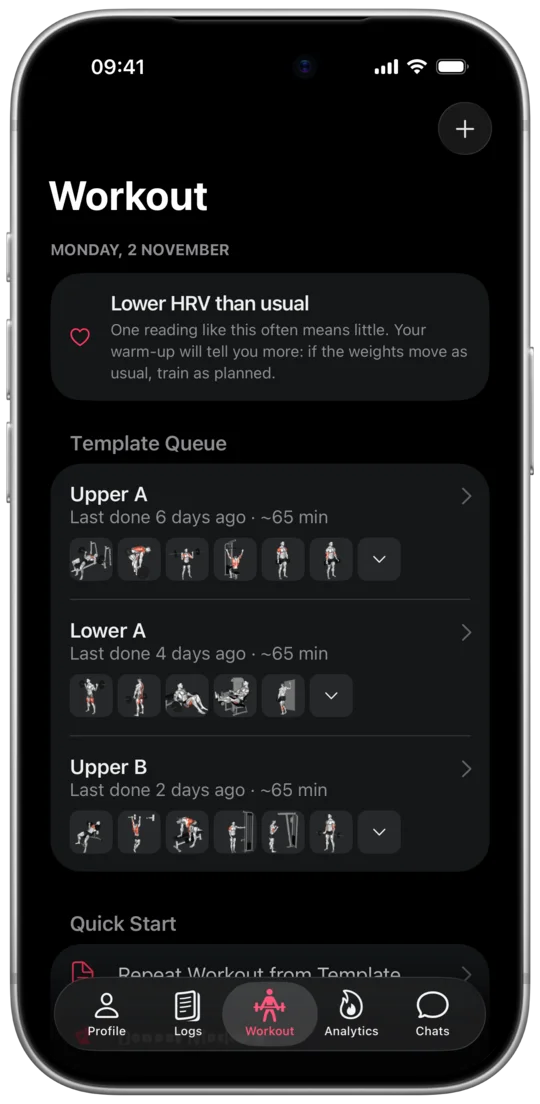
The Recovery Signal is a SmartWorkout beta on iPhone: from version 5.3 the app can read last night's sleep, HRV and resting heart rate from Apple Health and show a hint about today's effort on the Workout tab. We are testing it on some accounts, so not everyone has it in the app yet, and it does not work with Health Connect on Android yet.
| Signal | When it counts as weaker | Why |
|---|---|---|
| Your normal | We use the 28 days before today, with at least 7 days of readings. Without them there is no hint. | That's what it takes to see your usual spread. |
| HRV | Today is lower than average by at least one of your usual spreads, on a log scale. We treat the spread as no smaller than about 10%. | A drop from 40 to 36 ms weighs the same as one from 30 to 27 ms. After a few very even days, a 3% drop does not raise an alarm. |
| Resting heart rate | Only a higher rate than usual counts, by at least one spread and no less than 3 beats per minute. | A lower heart rate is no reason to hold back, and a smaller difference is within the watch's error. |
| Sleep | A night under 6 h, or 90 min shorter than your usual night (median). One under 5 h counts double. | For someone who usually sleeps 8 h, 6.5 h is a short night. |
A signal outside your normal gives one point, and one very far from it (two spreads, or sleep under 5 h) gives two. With one point you see the name of that signal, such as “Lower HRV than usual”, and a line saying that one reading like this often means little and your warm-up will tell you more; there is no advice to go lighter. With two or more you see “Go lighter today?” with conditional advice: if your first sets feel heavier than usual, leave more reps in reserve or do one set fewer.
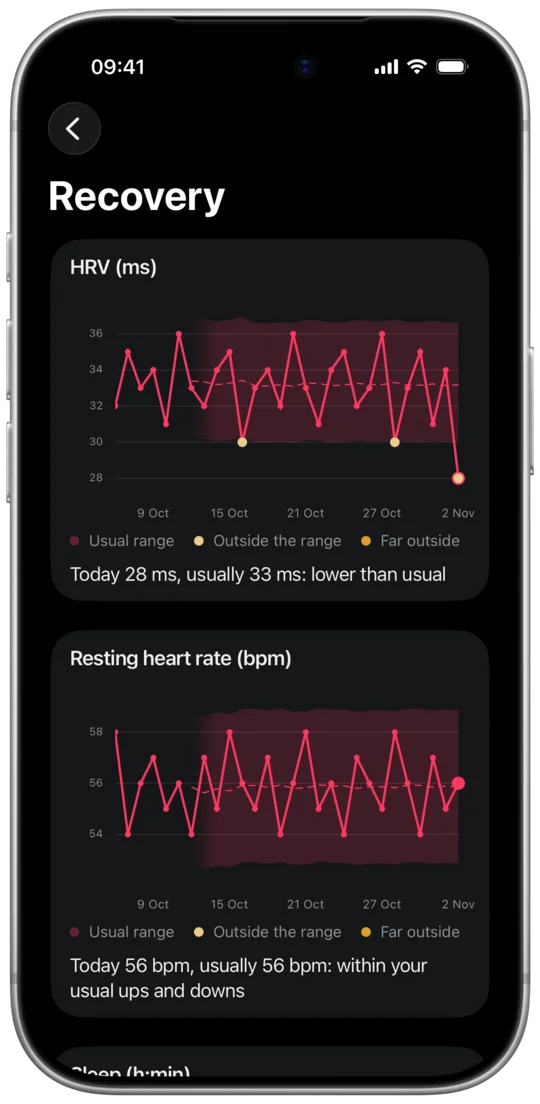
With a usual 33 ms and a calm spread, 28 ms gives one point, and only a reading under 27 ms gives two; if the night was also 2 h shorter than usual, the points add up and you see “Go lighter today?”.
A day runs from 6 p.m. to 6 p.m. and belongs to the morning you wake up in; until 4 a.m. the app still looks at the previous day. HRV and heart rate come from a single source, the one with the most readings, so a watch and a ring are never mixed. A day with no reading gets no rating, and a high HRV does not earn a “good” point.
The hint never changes your plan: with two points the app adds “Your plan stays the same.”, and whether to go lighter is your call. Sleep and heart rate data stay on your phone.
The recovery charts open from the card or from the Profile tab: HRV, resting heart rate and sleep over the last 4 weeks against your usual range, and over 3 months once you have at least a week of older readings.
How SmartWorkout works with Apple Health is covered in the help article Apple Health, Health Connect and Samsung Health.
Log it in SmartWorkout
A free workout log for iPhone and Android: sets, RIR, tempo, exercise groups and plans.


Questions
What is a good HRV?
A good HRV is one that sits within your usual range over the last 4 weeks. The number in milliseconds alone says little: 30 ms can be normal for one person and 50 ms for another, and both can be fine.
Why is my HRV low after the weekend?
Usually alcohol, a late heavy dinner, a lot of sugary caffeinated drinks or going to bed later. Once your routine is back, judge the average of the next few days, not a single morning.
Can I compare Apple Watch HRV with Garmin or Oura?
No. Apple Watch reports SDNN from short readings across the day, while other devices usually record RMSSD, calculated differently and at other times. The same heart gives two different numbers, so compare a device only with itself.
Should I work out with low HRV?
Yes, if you feel healthy. A single low reading often means little, so decide on effort after your warm-up: if the weights move as usual, train as planned, and if they feel clearly heavier, leave more reps in reserve or do one set fewer. Skip hard training if you have a fever or signs of an infection.
Is low HRV a sign of illness?
A single low reading from a watch is not a diagnosis and usually has an ordinary cause, such as a short night or alcohol. If HRV stays clearly lower for several weeks for no clear reason, or you have palpitations, shortness of breath or dizziness, see a doctor.
How can I raise my HRV?
Cutting out what lowers it works fastest: alcohol, caffeine late in the day, heavy dinners right before bed and short nights. Regular endurance training raises HRV moderately, while strength training alone barely changes it in healthy people.
See also
- RIR (reps in reserve): what it means and how to estimate itRIR (reps in reserve) is the number of good reps left before failure when a set ends. RIR 0 means no reps left, and RIR 2-3 in a plan means ending the set with 2-3 reps still in the tank. In a meta-analysis of 12 studies, lifters had on average 1 rep more left than they thought.
- Training to failure: when it helps and when it just adds fatigueTraining to failure means ending a set only when, despite full effort, you cannot complete the next rep through a full range of motion without changing your form. In a meta-analysis of 15 studies it built no significantly more muscle or strength than stopping short of failure, and it is clearly more fatiguing.
- Deload week: when to deload, how long it lasts and how much to cutA deload (deload week) is a planned week of lighter training that clears fatigue before the next block. Every deload cuts the number of sets, usually by 30-50%, and often ends sets further from failure. The weight stays the same or drops by about 10%, especially when your joints hurt.
- Supercompensation: what the theory says, how long it takes and why it is a simplificationSupercompensation is a model in which performance drops after training, recovers and briefly rises above the starting level. It is a simplification: strength usually returns within 1-3 days after a hard session, and the fitness-fatigue model better explains why a hard block pays off only after a lighter week.
- Training volume: what it is and what MEV, MAV and MRV meanIn hypertrophy training, training volume is the number of working sets a muscle group gets per week. In a meta-analysis of 67 studies, growth was measurable from about 4 weekly sets, with each extra set adding less; the 2026 ACSM position stand links 10 or more weekly sets to more growth.
- Training intensity: percentage of 1RM vs proximity to failure and how to increase itTraining intensity has two meanings in lifting: load as a percentage of one-rep max (%1RM) and effort, meaning how close to failure a set ends (RIR). At 80% of 1RM lifters average about 9 reps to failure on the bench press and 13 on the leg press. Muscle grows from about 30% of 1RM when sets end close to failure.
- Progressive overload: what it is, linear vs double progression, and how to break a plateauProgressive overload is the gradual increase of training demands, most often load, reps or sets. The ACSM advises adding 2-10% load once you do 1-2 reps over your target in two sessions in a row. In an 8-week study, adding reps built about as much muscle as adding load.
Sources
- Shaffer F, Ginsberg JP. An Overview of Heart Rate Variability Metrics and Norms. Front Public Health. 2017;5:258.
- Apple Inc. Using Apple Watch to measure heart rate, calorimetry, and activity. November 2024.
- Android Developers. HeartRateVariabilityRmssdRecord (Health Connect client).
- O'Grady B, Lambe R, Baldwin M, et al. The Validity of Apple Watch Series 9 and Ultra 2 for Serial Measurements of Heart Rate Variability and Resting Heart Rate. Sensors (Basel). 2024;24(19):6220.
- Nunan D, Sandercock GR, Brodie DA. A quantitative systematic review of normal values for short-term heart rate variability in healthy adults. Pacing Clin Electrophysiol. 2010;33(11):1407-1417.
- Kupper NH, Willemsen G, van den Berg M, et al. Heritability of ambulatory heart rate variability. Circulation. 2004;110(18):2792-2796.
- Umetani K, Singer DH, McCraty R, Atkinson M. Twenty-four hour time domain heart rate variability and heart rate: relations to age and gender over nine decades. J Am Coll Cardiol. 1998;31(3):593-601.
- Natarajan A, Pantelopoulos A, Emir-Farinas H, Natarajan P. Heart rate variability with photoplethysmography in 8 million individuals: a cross-sectional study. Lancet Digit Health. 2020;2(12):e650-e657.
- Sandercock GR, Bromley PD, Brodie DA. Effects of exercise on heart rate variability: inferences from meta-analysis. Med Sci Sports Exerc. 2005;37(3):433-439.
- Bhati P, Moiz JA, Menon GR, Hussain ME. Does resistance training modulate cardiac autonomic control? A systematic review and meta-analysis. Clin Auton Res. 2019;29(1):75-103.
- Buchheit M. Monitoring training status with HR measures: do all roads lead to Rome? Front Physiol. 2014;5:73.
- Plews DJ, Laursen PB, Stanley J, Kilding AE, Buchheit M. Training adaptation and heart rate variability in elite endurance athletes: opening the door to effective monitoring. Sports Med. 2013;43(9):773-781.
- Pietilä J, Helander E, Korhonen I, et al. Acute Effect of Alcohol Intake on Cardiovascular Autonomic Regulation During the First Hours of Sleep in a Large Real-World Sample of Finnish Employees: Observational Study. JMIR Ment Health. 2018;5(1):e23.
- Tada Y, Yoshizaki T, Tanaka I, et al. Higher energy intake at dinner decreases parasympathetic activity during nighttime sleep in menstruating women: A randomized controlled trial. Physiol Behav. 2018;194:252-259.
- Uçar C, Özgöçer T, Yıldız S. Effects of late-night eating of easily-or slowly-digestible meals on sleep, hypothalamo-pituitary-adrenal axis, and autonomic nervous system in healthy young males. Stress Health. 2021;37(4):640-649.
- Almeida BA, Morales AP, Ribeiro JRC, et al. Impact of Caffeine Intake Strategies on Heart Rate Variability during Post-Exercise Recovery: A Systematic Review and Meta-Analysis. Curr Cardiol Rev. 2024;20(3):87-100.
- Drake C, Roehrs T, Shambroom J, Roth T. Caffeine effects on sleep taken 0, 3, or 6 hours before going to bed. J Clin Sleep Med. 2013;9(11):1195-1200.
- Chapman CL, Reed EL, Worley ML, et al. Sugar-sweetened soft drink consumption acutely decreases spontaneous baroreflex sensitivity and heart rate variability. Am J Physiol Regul Integr Comp Physiol. 2021;320(5):R641-R652.
- Zhang S, Niu X, Ma J, et al. Effects of sleep deprivation on heart rate variability: a systematic review and meta-analysis. Front Neurol. 2025;16:1556784.
- Kalkanis A, Lenkens D, Steiropoulos P, Testelmans D. Sleep regularity as an important component of sleep hygiene: a systematic review. Sleep Med Rev. 2025;84:102203.
- Abellán-Aynés O, Manonelles P, Alacid F. Cardiac Parasympathetic Withdrawal and Sympathetic Activity: Effect of Heat Exposure on Heart Rate Variability. Int J Environ Res Public Health. 2021;18(11):5934.
- Young HA, Cousins A, Johnston S, et al. Autonomic adaptations mediate the effect of hydration on brain functioning and mood: Evidence from two randomized controlled trials. Sci Rep. 2019;9(1):16412.
- Christiani M, Grosicki GJ, Flatt AA. Cardiac-autonomic and hemodynamic responses to a hypertonic, sugar-sweetened sports beverage in physically active men. Appl Physiol Nutr Metab. 2021;46(10):1189-1195.
- Hirten RP, Danieletto M, Tomalin L, et al. Use of Physiological Data From a Wearable Device to Identify SARS-CoV-2 Infection and Symptoms and Predict COVID-19 Diagnosis: Observational Study. J Med Internet Res. 2021;23(2):e26107.
- Mishra T, Wang M, Metwally AA, et al. Pre-symptomatic detection of COVID-19 from smartwatch data. Nat Biomed Eng. 2020;4(12):1208-1220.
- Chen JL, Yeh DP, Lee JP, et al. Parasympathetic nervous activity mirrors recovery status in weightlifting performance after training. J Strength Cond Res. 2011;25(6):1546-1552.
- Stanley J, Peake JM, Buchheit M. Cardiac parasympathetic reactivation following exercise: implications for training prescription. Sports Med. 2013;43(12):1259-1277.
- Kim HG, Cheon EJ, Bai DS, Lee YH, Koo BH. Stress and Heart Rate Variability: A Meta-Analysis and Review of the Literature. Psychiatry Investig. 2018;15(3):235-245.
- Watson NF, Badr MS, Belenky G, et al. Recommended Amount of Sleep for a Healthy Adult: A Joint Consensus Statement of the American Academy of Sleep Medicine and Sleep Research Society. Sleep. 2015;38(6):843-844.
- Craven J, McCartney D, Desbrow B, et al. Effects of Acute Sleep Loss on Physical Performance: A Systematic and Meta-Analytical Review. Sports Med. 2022;52(11):2669-2690.
- Knowles OE, Drinkwater EJ, Urwin CS, Lamon S, Aisbett B. Inadequate sleep and muscle strength: Implications for resistance training. J Sci Med Sport. 2018;21(9):959-968.
- Pareja-Blanco F, Rodríguez-Rosell D, Sánchez-Medina L, et al. Acute and delayed response to resistance exercise leading or not leading to muscle failure. Clin Physiol Funct Imaging. 2017;37(6):630-639.
- Düking P, Zinner C, Trabelsi K, et al. Monitoring and adapting endurance training on the basis of heart rate variability monitored by wearable technologies: A systematic review with meta-analysis. J Sci Med Sport. 2021;24(11):1180-1192.
- DeBlauw JA, Drake NB, Kurtz BK, et al. High-Intensity Functional Training Guided by Individualized Heart Rate Variability Results in Similar Health and Fitness Improvements as Predetermined Training with Less Effort. J Funct Morphol Kinesiol. 2021;6(4):102.