Building muscle in numbers
Building muscle rests on progressive overload and eating with a small calorie surplus.
| Parameter | Value | Source |
|---|---|---|
| Rate of gain | 0.25-0.5% of body weight per week, slower for advanced lifters | Iraki et al. 2019 |
| Calorie surplus | 10-20% in the review, 200-300 kcal for very well-trained lifters; about 5% to start (our practice), then adjust in steps | Iraki et al. 2019 |
| Protein | 1.6-2.2 g per kg of body weight per day | Iraki et al. 2019 |
| Compound lifts | some sets heavy, 3-8 reps | Schoenfeld et al. 2017 |
| Other exercises | 6-12 reps, RIR 1-2 | our practice |
| Sets | from the low end of MEV, added between blocks | our practice |
Hypertrophy or strength: one plan for both
Muscle and strength grow together, so you don't need two plans. A meta-analysis of 21 studies found that 1RM strength rises more with heavy sets (above 60% 1RM), while hypertrophy is similar with light and heavy loads (Schoenfeld et al. 2017).
So you do compound lifts such as the squat or bench press in the strength range, because those are the lifts you track your strength on, and the other exercises in the hypertrophy range: they build muscle just as well and are easier on the joints.
How to set up training on a bulk: 6 steps
- Pick a plan with a compound lift for every muscle group, e.g. the 4-day upper-lower plan or the 3-day full body plan.
- Aim for a gain of 0.25-0.5% of body weight per week and track it with the average of 7 morning weigh-ins.
- Start at the low end of MEV and, in later blocks, add 1-2 sets to muscle groups that aren't growing.
- Add reps or weight every week, following double progression.
- After 4-8 weeks, take a deload and start the next block, as the mesocycle page explains.
- Every 2 weeks, compare your average weight with the plan and adjust calories using the table in the section on adjusting.
Calories on a bulk: where to start
You set calories on a bulk the same way as on a cut, just in reverse. The formula is only a starting point: Mifflin-St Jeor gets within 10% of resting metabolic rate more often than three other popular equations, but for any one person it can be further off (Frankenfield et al. 2005).
- Work out your resting metabolic rate with the Mifflin-St Jeor equation (Mifflin et al. 1990): men: 10 × weight in kg + 6.25 × height in cm − 5 × age in years + 5; women: the same, but − 161 at the end instead of + 5. The calorie calculator does this step and the next two for you.
- Multiply the result by a rough activity multiplier from nutrition guides: about 1.5 if you train 3-4 times a week and have a desk job. More movement during the day puts the multiplier closer to 1.7, less puts it around 1.3.
- To start, add about 5% to that maintenance number. At 2,600 kcal that's about 2,730 kcal; you'll get to 10-15% in later steps if your weight stalls.
- For 2 weeks, eat the same amount every day, weekends included.
- Weigh yourself in the morning, after the bathroom and before eating, ideally every day, and take the average for the whole week. A single weigh-in, such as 1-2 kg more after a weekend, moves with water, salt and food, so you make decisions from the average only.
The first week of a bulk usually shows a bigger jump than planned, because you gain water, glycogen and food sitting in your stomach and gut. That's why you judge the rate only from the second week on.
How to adjust calories every 2 weeks
After each change you wait 2 weeks, because that's how long the average needs to show the effect.
| What the 2-week average shows | What you do |
|---|---|
| rising about 0.25-0.5% per week | nothing, keep eating the same |
| flat or rising slower than 0.25% per week | add 150-200 kcal a day |
| rising faster than 0.5% per week | drop 150-200 kcal a day |
Over time the surplus shrinks on its own, because a heavier body burns more energy. With only a few kilograms gained, though, the difference is small, so a stalled bulk more often means you're eating less than you planned.
Example: the first weeks of a bulk
Progress on your lifts after 8 weeks of a bulk at 0.25-0.5% per week.
| Exercise | Week 1 | Week 8 | What changed |
|---|---|---|---|
| Barbell Squat | 4 × 5 at 100 kg | 4 × 5 at 107.5 kg | weight, strength range |
| Barbell Bench Press | 3 × 6 at 80 kg | 3 × 8 at 82.5 kg | reps, then weight |
| Incline Dumbbell Bench Press | 3 × 10 at 22 kg | 4 × 10 at 24 kg | a set and weight for a slow-growing muscle group |
Calories and weight over 7 weeks
A man, 75 kg, 180 cm, 25 years old, 4 sessions a week, desk job. Resting metabolic rate from the formula: about 1,750 kcal; maintenance with a 1.5 multiplier: about 2,630 kcal. A 5% surplus is about 130 kcal: start at 2,750 kcal. A rate of 0.25-0.5% is 0.2-0.4 kg per week.
| Week | Kcal per day | Average weight | Change | Decision |
|---|---|---|---|---|
| 0 (before) | not counted | 75.0 kg | work out maintenance | |
| 1 | 2,750 | 75.5 kg | +0.5 kg | water, glycogen and food, don't react |
| 2 | 2,750 | 75.5 kg | 0 | wait for the second week |
| 3 | 2,750 | 75.6 kg | +0.1 kg | 2 weeks with almost no change: 2,950 kcal from now on |
| 4 | 2,950 | 75.8 kg | +0.2 kg | wait for the second week |
| 5 | 2,950 | 76.0 kg | +0.2 kg | +0.2 kg on average, on pace: surplus found |
| 6 | 2,950 | 76.3 kg | +0.3 kg | on pace |
| 7 | 2,950 | 76.5 kg | +0.2 kg | on pace |
Over 7 weeks there was one change, and weight went up 1.5 kg, part of it water and glycogen from the first week. Estimating maintenance from your weight works differently on a bulk than on a cut: we count a kilogram gained roughly as 5,000 kcal, less than a kilogram lost, because in lean people 60-70% of the gain is lean tissue (Forbes 2000). So maintenance is your average calories minus your weekly gain in kg × 700; 5,000 and 700 are our simplification, not a study result. Weeks 4-7 (2,950 kcal, +0.22 kg on average) give about 2,950 − 150, or 2,800 kcal, close to the formula.
Common situations on a bulk
Your weight is flat despite an adjustment. On a bulk this most often means you're eating less than you think: appetite drops, meals get skipped on busy days. Add 150-200 kcal and give it another 2 weeks; one extra snack is easier than making every meal bigger. In women, body weight is higher in the mid-luteal phase than in the mid-follicular phase (Kosar et al. 2022), so compare the same phase of the cycle or look at 4 weeks instead of 2.
Your weight goes up, but your strength doesn't. If the average is rising on pace, food isn't the problem, and more calories will add mostly fat. Check your training: whether you add reps or weight every week with progressive overload, how many sets that muscle group gets, and whether your last deload was a long time ago.
Common mistakes
- Too big a surplus. In trained lifters, faster weight gain mostly increased skinfold thickness, that is, fat; squat strength and muscle thickness rose about the same with every surplus (Helms et al. 2023). In athletes with a bigger surplus, body weight rose 3.9% vs 1.5% and fat mass 15% vs 3%, while lean mass didn't differ between the groups (Garthe et al. 2013).
- Only light sets. Your muscles will grow, but your 1RM will go up less; keep the heavy compound lifts.
- An endless bulk. A bulk ends with a cut; how to plan one is covered in training on a cut.
What the research says
| Study | Type and sample | Result | Limitation |
|---|---|---|---|
| Iraki et al. 2019 | review, natural bodybuilders in the off-season | surplus of ~10-20%, gain of 0.25-0.5% of body weight per week for novices and intermediates, slower for advanced lifters; protein 1.6-2.2 g/kg | recommendations from a review |
| Helms et al. 2023 | randomized trial, 17 trained lifters, 8 weeks, surplus of 0%, 5% and 15% | faster weight gain added mainly fat; no difference in squat or muscle thickness, bench press better at 15% | small sample |
| Garthe et al. 2013 | randomized trial, 39 elite athletes, 8-12 weeks | bigger surplus: more body weight and fat, no difference in lean mass; 1RM +6-12% in both groups | elite athletes |
| Schoenfeld et al. 2017 | meta-analysis of 21 studies | heavy sets give more 1RM strength, hypertrophy similar with light and heavy loads | all sets taken to failure |
| Forbes 2000 | review of body composition studies | in a surplus, 60-70% of the gain is lean tissue in lean people, 30-40% in people with obesity | mostly untrained people |
| Mifflin et al. 1990 | 498 healthy adults, resting metabolic rate measured by calorimetry | an equation for resting metabolic rate from weight, height, age and sex | adults aged 19-78, almost half with obesity |
| Frankenfield et al. 2005 | systematic review of resting metabolic rate equations | Mifflin-St Jeor is most often within 10%, but individual errors can be large | resting metabolic rate only, no daily activity |
Building muscle in SmartWorkout
- On the Workout tab, pick a ready-made plan or build your own in the plan creator.
- Log your body weight on the “Weight” screen; once you set a goal weight, you'll see how much is left “to goal”.
- When the plan ends, extend it with another block: while editing the plan, long-press the tab of the last block and choose “Clone”.
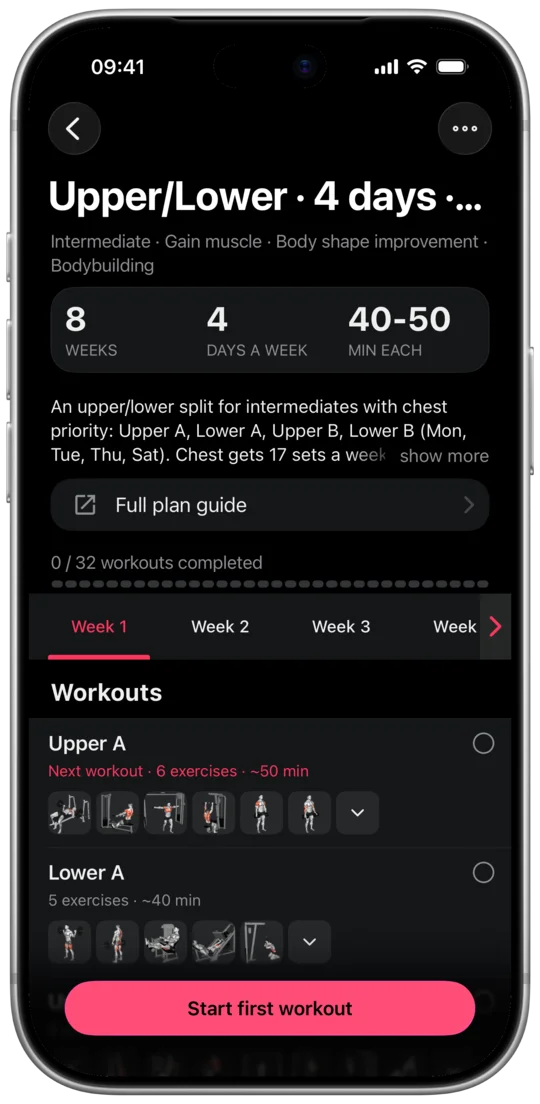
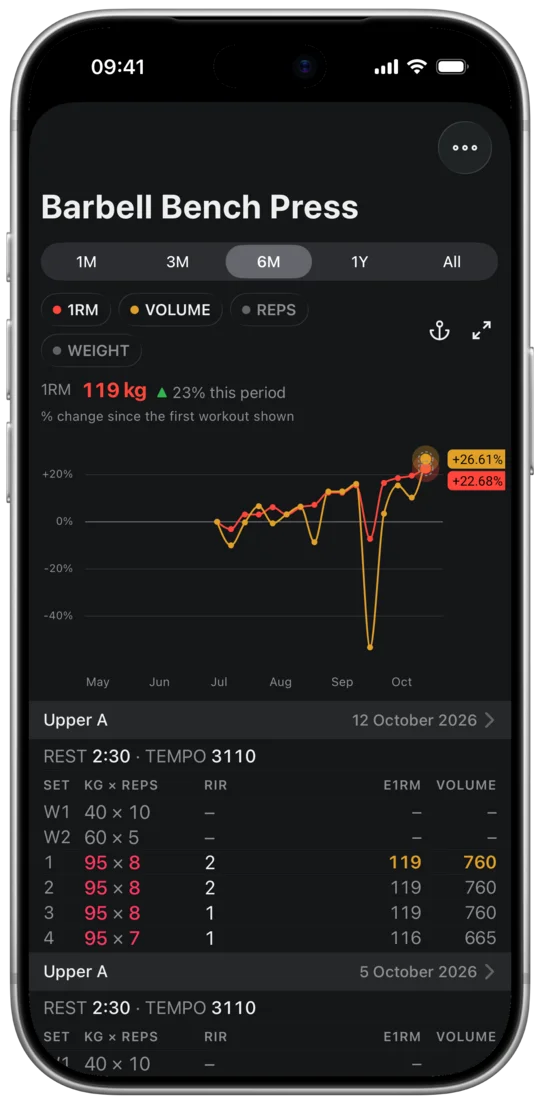
The SmartWorkout app doesn't count calories or your weekly average weight: the calorie calculator gives you your starting calories, the rules above give you the adjustments, and the “Weight” screen shows all your weigh-ins on a chart. Whether the bulk is turning into strength you can check on the exercise chart: your estimated 1RM on the main lifts should go up from block to block.
You can count weekly sets per muscle group in the volume calculator and your starting calories in the calorie calculator.
Log it in SmartWorkout
A free workout log for iPhone and Android: sets, RIR, tempo, exercise groups and plans.


Questions
How much weight should I gain per week when building muscle?
About 0.25-0.5% of body weight per week: 0.2-0.4 kg at 80 kg, 0.25-0.5 kg at 100 kg. The longer you've been training, the closer you should stay to the lower end.
Are training for size and training for strength two different plans?
They don't have to be. Heavy sets build strength best, while hypertrophy is similar across a wide range of reps, so one plan with heavy compound lifts and 6-12 reps in the other exercises covers both.
Will a bigger surplus give faster results?
Usually not. In trained lifters, faster weight gain added mostly fat; squat strength and muscle thickness rose about the same, and only the bench press did better with a 15% surplus.
See also
- Training on a cut: how to lift so you keep your muscleA cut is strength training in a calorie deficit, aimed at keeping your muscle and your lifts. The plan stays the same, the diet changes: body weight should drop by about 0.5% per week, up to 1% only with a lot of body fat. In a deficit, muscle grows less, while strength rises about as much as without one.
- How to make a workout plan for the gym: exercises, sets, order and session lengthA workout plan (or workout program) is a written training week: days, exercises, sets, reps, reps in reserve (RIR) and rest. To make one, start with the number of days, then pick exercises and count weekly sets per muscle group. The 2026 ACSM position stand advises at least 2 sets per exercise and 2-3 reps in reserve.
- Rep ranges: how many reps for hypertrophy, strength and cuttingA rep range is the span of reps, such as 8-12, in which a set with a given weight should end. For muscle growth the exact number matters little: in studies, muscle grew similarly with sets of about 5 to more than 30 reps close to failure, while strength grew most with loads of 80% of 1RM or more.
- Progressive overload: what it is, linear vs double progression, and how to break a plateauProgressive overload is the gradual increase of training demands, most often load, reps or sets. The ACSM advises adding 2-10% load once you do 1-2 reps over your target in two sessions in a row. In an 8-week study, adding reps built about as much muscle as adding load.
- Training volume: what it is and what MEV, MAV and MRV meanIn hypertrophy training, training volume is the number of working sets a muscle group gets per week. In a meta-analysis of 67 studies, growth was measurable from about 4 weekly sets, with each extra set adding less; the 2026 ACSM position stand links 10 or more weekly sets to more growth.
- Mesocycle training: how long a training block lasts and how to plan oneA mesocycle (training block) is a block of several weeks, usually 4-8, built around one goal and often ending with a lighter week (deload). It is made of microcycles, usually one training week each, and several mesocycles form a macrocycle, usually a year.
- Deload week: when to deload, how long it lasts and how much to cutA deload (deload week) is a planned week of lighter training that clears fatigue before the next block. Every deload cuts the number of sets, usually by 30-50%, and often ends sets further from failure. The weight stays the same or drops by about 10%, especially when your joints hurt.
- Workout splits: full body, upper/lower, push pull legs or bro splitA workout split is how you spread muscle groups across the week. Full body trains everything each session, upper/lower and push pull legs rotate 2 or 3 day types, and a bro split gives each muscle its own day. With equal weekly sets, full body and splits build similar muscle and strength (meta-analysis of 14 studies).
Sources
- Iraki J, Fitschen P, Espinar S, Helms E. Nutrition Recommendations for Bodybuilders in the Off-Season: A Narrative Review. Sports (Basel). 2019;7(7):154.
- Helms ER, Spence AJ, Sousa C, et al. Effect of Small and Large Energy Surpluses on Strength, Muscle, and Skinfold Thickness in Resistance-Trained Individuals: A Parallel Groups Design. Sports Med Open. 2023;9(1):102.
- Garthe I, Raastad T, Refsnes PE, Sundgot-Borgen J. Effect of nutritional intervention on body composition and performance in elite athletes. Eur J Sport Sci. 2013;13(3):295-303.
- Schoenfeld BJ, Grgic J, Ogborn D, Krieger JW. Strength and Hypertrophy Adaptations Between Low- vs. High-Load Resistance Training: A Systematic Review and Meta-analysis. J Strength Cond Res. 2017;31(12):3508-3523.
- Mifflin MD, St Jeor ST, Hill LA, Scott BJ, Daugherty SA, Koh YO. A new predictive equation for resting energy expenditure in healthy individuals. Am J Clin Nutr. 1990;51(2):241-7.
- Frankenfield D, Roth-Yousey L, Compher C. Comparison of predictive equations for resting metabolic rate in healthy nonobese and obese adults: a systematic review. J Am Diet Assoc. 2005;105(5):775-89.
- Forbes GB. Body fat content influences the body composition response to nutrition and exercise. Ann N Y Acad Sci. 2000;904:359-65.
- Kosar SN, Guzel Y, Kose MG, Kin Isler A, Hazir T. Whole and segmental body composition changes during mid-follicular and mid-luteal phases of the menstrual cycle in recreationally active young women. Ann Hum Biol. 2022;49(2):124-132.