Training on a cut in numbers
Training on a cut uses the same plan as a bulk with a different goal: keep your weights rather than push them up.
| Parameter | Value | Source |
|---|---|---|
| Rate of loss | 0.5% of body weight per week, up to 1% only with a lot of body fat | Helms et al. 2014 |
| Deficit | 10-15% of maintenance to start, then steps of 150-200 kcal | our practice |
| Maximum deficit | 20-30% of maintenance, depending on your build | our practice, 30% from Jensen et al. 2014 |
| Plan and exercises | the same as before the cut | our practice |
| Reps | the same ranges, usually 6-12, 3-15 overall | Helms et al. 2015 |
| Sets | priority muscle group unchanged, the rest down to the low end of MEV, nothing added | our practice |
| Reps in reserve | RIR 1-2, only the last set of an isolation exercise goes to failure, if any | our practice |
Should you change your plan on a cut
On a cut you change your diet, and your plan can stay the same: your muscles need the same stimulus as before. A meta-analysis found that in a deficit lean mass grows less, while strength rises about as much as without one. A deficit of about 500 kcal a day blunted muscle gain (Murphy and Koehler 2022). Holding your weights through the whole cut is a good result, not a plateau.
What changes is what you expect from progressive overload. On a bulk you add reps and weight every block; on a cut it's enough that your numbers don't drop. When the cut ends, you go back to a regular mesocycle and base your weights on the last weeks of the cut.
How to set up training on a cut: 6 steps
- Keep your exercises, rep ranges and number of sessions per week; take your weights from the last regular week before the cut.
- Set your rate of loss from the rate table for your build in the calories section, usually 0.5% of body weight per week, and track it with the average of 7 morning weigh-ins.
- Keep the sets of your priority muscle group; you can take other muscle groups down to the low end of MEV. Don't add sets during the cut.
- End your sets at RIR 1-2. At most, the last set of an isolation exercise goes to failure, never the heavy lifts.
- If the weight or reps in an exercise drop for 2 weeks in a row, first check that you aren't losing weight too fast, then remove 1 set for that muscle group or take a lighter week.
- Deload as on a bulk, at the end of a block after 4-8 weeks.
A slower rate helps your muscle: in a study of 24 athletes, lean mass rose by 2.1% in the group losing 0.7% of body weight per week (8.5 weeks on average), while in the group that lost 1.0% per week (5.3 weeks on average) it didn't change (Garthe et al. 2011). Both groups did strength training 4 times a week.
How much to eat on a cut: start with a small deficit
A maintenance formula is only a starting point: Mifflin-St Jeor gets within 10% of resting metabolic rate more often than three other popular equations, but for any one person it can be further off (Frankenfield et al. 2005). That's why you start with a small deficit: if the formula overestimated your maintenance, a full deficit from day one would be much bigger than you planned.
- Work out your resting metabolic rate with the Mifflin-St Jeor equation (Mifflin et al. 1990): men: 10 × weight in kg + 6.25 × height in cm − 5 × age in years + 5; women: the same, but − 161 at the end instead of + 5. The calorie calculator does this step and the next two for you.
- Multiply the result by a rough activity multiplier from nutrition guides: about 1.5 if you train 3-4 times a week and have a desk job. More movement during the day puts the multiplier closer to 1.7, less puts it around 1.3.
- To start, take about 10% off that maintenance number, or about 15% if you carry a lot of fat. At 2,800 kcal that's about 2,500 kcal.
- For 2 weeks, eat the same amount every day, weekends included.
- Weigh yourself in the morning, after the bathroom and before eating, ideally every day, and take the average for the whole week. A single weigh-in, such as 1-2 kg more after a weekend, moves with water, salt and food, so you make decisions from the average only.
The first week of a cut usually shows a bigger drop than planned, because you lose water and glycogen. That's why you judge the rate only from the second week on.
The rate depends on how much fat you carry
You match the rate of a cut to your body fat, not to your weight alone. The less fat you start with, the larger the share of lost weight that is lean tissue, and a bigger deficit raises that share further (Forbes 2000). That's why 100 kg at 20% body fat is a different cut from 150 kg at 40%.
| Build | Target rate | Starting deficit | Maximum deficit |
|---|---|---|---|
| lean: men under 15% body fat, women under 23% | 0.5% of body weight per week | 10% of maintenance | 20% |
| average: 15-25% for men, 23-33% for women | 0.5-0.75% | 10% | 25% |
| a lot of fat: above 25% for men, 33% for women | 0.75-1% | 15% | 30%, no more than 1,000 kcal |
The thresholds in the table are our practice; the rate of 0.5-1% per week comes from recommendations for natural bodybuilders (Helms et al. 2014), and the deficit cap from obesity treatment guidelines, which give 500-750 kcal or 30% (Jensen et al. 2014). If you don't know your body fat percentage, pick the row by what you see in the mirror: BMI misleads muscular people, because 100 kg at 185 cm is a BMI of 29 even at 20% body fat.
At 150 kg, a 1% rate is about 1.5 kg per week, a deficit close to half of maintenance. The 30% and 1,000 kcal cap stops you earlier, at about 0.6-0.7% per week, and that's the point.
How to increase the deficit every 2 weeks
In a study of 14 trained women, increasing the deficit gradually gave similar fat loss and similar strength as the full deficit from day one (Vargas-Molina et al. 2023). It's a small study, but a review on adaptation to weight loss in athletes recommends exactly this: gradual, small deficits (Trexler et al. 2014).
| What the 2-week average shows | What you do |
|---|---|
| dropping slower than 3/4 of the rate in the table, and you stick to the plan | drop 150-200 kcal a day |
| dropping at about the rate in the table | keep calories as they are: this is your deficit |
| dropping more than 1/4 faster than the rate in the table, or faster than 1% | add 150-200 kcal a day |
| dropping on pace, but your lifts fall for 2 weeks | calories stay; remove a set for that muscle group or take a lighter week (step 5) |
The steps end in one of three places: your weight drops on pace, the deficit reaches the cap from the table, or calories reach the floor. The floor is your resting metabolic rate from the formula, and no less than 1,500 kcal for men and 1,200 kcal for women; that's our floor, taken from the lowest values the guidelines recommend (Jensen et al. 2014). If you're at the floor and your weight is flat, don't cut further: spend 1-2 weeks at maintenance and only then go back to the deficit. Usually 2-3 steps are enough, so you reach your target deficit in week 6-8.
Don't cut if you're under 18, pregnant, have a BMI below 18.5 or an eating disorder. If your period stops during a cut, go back to eating at maintenance and see a doctor.
Your real maintenance from your weight
After 4 weeks of steady eating, your weight tells you more than the formula. Maintenance is your average daily calories plus the weekly drop in average weight × 1,000: a kilogram lost is roughly 7,000 kcal, or 1,000 kcal a day over a week. You eat 2,150 kcal and lose 0.45 kg per week, so your maintenance is about 2,150 + 450 = 2,600 kcal.
The result is reliable only after about 4 weeks: with daily weigh-ins it takes more than 28 days for the estimate of changes in intake to fall within ±300 kcal a day (Hall and Chow 2011). The 7,000 figure is a simplification: the popular 7,700 kcal per kilogram fits people with more than 30 kg of fat and overestimates for leaner ones (Hall 2008). Leave out the first week of the cut and the week after each calorie change, because in those weeks it's mostly water that moves.
Example: the first weeks of a cut
The same lifts before and during a cut, with the point at which you react.
| Exercise | Before the cut | On the cut | When to act |
|---|---|---|---|
| Barbell Bench Press | 3 × 6 at 100 kg, RIR 1 | 3 × 6 at 100 kg, RIR 1-2 | 3 × 5 at 92.5 kg for 2 weeks in a row: check your rate, then one fewer set for chest |
| Barbell Squat | 4 × 6-8 at 120 kg | 4 × 6-8 at 120 kg | when 8 reps turn into 6 for 2 weeks, check your rate of loss, then remove a set |
| Dumbbell Lateral Raise | 4 sets, priority muscle group | 4 sets | the sets stay, because it's the priority muscle group |
A drop of 1-2 reps in the first week of a cut doesn't have to mean muscle loss. Act only on a drop that lasts 2 weeks.
Calories and weight over 7 weeks
A man, 90 kg, 182 cm, 32 years old, about 20% body fat, 4 sessions a week, desk job. Resting metabolic rate from the formula: about 1,880 kcal; maintenance with a 1.5 multiplier: about 2,800 kcal. An average build, so a target rate of 0.5% (0.45 kg per week), a starting deficit of 10%: 2,500 kcal, and a deficit cap of 25%: no lower than 2,100 kcal.
| Week | Kcal per day | Average weight | Change | Decision |
|---|---|---|---|---|
| 0 (before) | not counted | 90.0 kg | work out maintenance | |
| 1 | 2,500 | 89.3 kg | −0.7 kg | water and glycogen, don't react |
| 2 | 2,500 | 89.1 kg | −0.2 kg | wait for the second week |
| 3 | 2,500 | 88.9 kg | −0.2 kg | 2 weeks at 0.2 kg, slower than 0.45: 2,300 kcal from now on |
| 4 | 2,300 | 88.6 kg | −0.3 kg | wait for the second week |
| 5 | 2,300 | 88.3 kg | −0.3 kg | still slower than planned: 2,150 kcal from now on |
| 6 | 2,150 | 87.9 kg | −0.4 kg | wait for the second week |
| 7 | 2,150 | 87.4 kg | −0.5 kg | 0.45 kg on average, on pace: deficit found |
Week 6 is the first week after a change, so you calculate from week 7: for now that gives about 2,150 + 500, or 2,650 kcal, 150 less than the formula; you'll get a solid number from 4 weeks at 2,150 kcal without the week after the change, that is weeks 7-10. The bench press and squat stayed at the same weights through these 7 weeks.
Recomposition: a cut on which you get stronger
Body recomposition is gaining muscle while losing body fat. A review shows it happens in beginners and overweight people, and also in trained lifters, as long as training is progressive and the diet well planned (Barakat et al. 2020).
In practice you don't plan it separately. You run a cut at about 0.5% per week and watch your numbers:
| What you see after 4 weeks | What it means |
|---|---|
| weight going down, weights and reps going up | recomposition: keep the plan and the rate |
| weight going down, lifts flat | a normal cut: that's how it should be |
| weight going down, lifts dropping 2 weeks in a row | check your rate: too fast, reduce the deficit; on pace, remove a set (step 5) |
Recomposition is easiest if you're new to training or carry a lot of body fat, because then your lifts rise despite the deficit. The longer you train and the leaner you are, the more often a cut ends with simply holding your numbers.
Common situations on a cut
Your average is flat even though you hit your calories on weekdays. Weekends may be eating your deficit: in one study, people on a diet lost weight during the week and stopped on weekends, because they ate more then (Racette et al. 2008). In that case it's easier to plan the weekend ahead, for example 200 kcal less Monday to Friday and 500 kcal more on Saturday and Sunday, than to cut calories every day.
Your weight is flat despite an adjustment. First check that you take your averages from morning weigh-ins in similar conditions and that your portions haven't crept up "by eye": in a model built on study data, the weight plateau after about half a year of dieting was explained mainly by on-and-off adherence to the diet, not by a slower metabolism (Thomas et al. 2014). If they do, drop 150-200 kcal and give it another 2 weeks. In women, body weight is higher in the mid-luteal phase than in the mid-follicular phase (Kosar et al. 2022), so compare the same phase of the cycle or look at 4 weeks instead of 2. If your weights and reps go up during that time, it may be recomposition, and then you change nothing.
Common mistakes
- A new plan at the start of the cut. New exercises leave you nothing to compare with your pre-deficit numbers; keep the plan and change it after the cut.
- Losing weight too fast. Start with a small deficit and aim for 0.5%; when your lifts drop, reduce the deficit first and the training second.
- Adding sets to burn more. Extra sets don't replace a deficit in your food; take the calories out of your diet and keep your set count.
- High reps “for definition”. A range of 3-15 reps, mostly 6-12, is recommended even before contests (Helms et al. 2015); don't swap it for sets of 20.
What the research says
The evidence on training during a cut comes from a meta-analysis of studies with a calorie deficit, from studies on athletes and from reviews for bodybuilders, so the gym advice here is extrapolated from those groups.
| Study | Type and sample | Result | Limitation |
|---|---|---|---|
| Murphy and Koehler 2022 | meta-analysis of strength training studies with and without a calorie deficit | lean mass rose less (ES -0.57), strength about the same (ES -0.31, p = 0.28); a deficit of about 500 kcal a day blunted gains | doesn't test how many sets to do in a deficit |
| Garthe et al. 2011 | randomized trial, 24 athletes, 4 strength sessions a week | 0.7% of body weight per week: lean mass +2.1%; 1.0% per week (planned 1.4%): no change | small sample, elite athletes |
| Helms et al. 2014 | review, natural bodybuilding contest preparation | a rate of 0.5-1% of body weight per week to keep as much muscle as possible | recommendations from a review, not a single study |
| Helms et al. 2015 | review of training before contests | 3-15 reps, mostly 6-12 | recommendations from a review |
| Barakat et al. 2020 | review of recomposition studies | simultaneous muscle gain and fat loss also reported in trained people; progressive training and diet are the conditions | narrative review, different body composition methods |
| Forbes 2000 | review of body composition studies | the less fat at the start, the larger the share of weight lost that is lean tissue; a bigger deficit raises it further | data mostly from untrained people |
| Jensen et al. 2014 | AHA/ACC/TOS guideline for treating obesity | a deficit of 500-750 kcal or 30%, usually 1,200-1,500 kcal for women and 1,500-1,800 kcal for men | adults with overweight and obesity |
| Vargas-Molina et al. 2023 | randomized trial, 14 trained women, 8 weeks | a deficit increased every 2 weeks gave similar body composition and strength as the full deficit from the start | very small sample |
| Hall and Chow 2011 | mathematical model on study data | with daily weigh-ins, more than 28 days to estimate a change in intake within ±300 kcal | a model, not measured in lifters |
| Thomas et al. 2014 | model on weight-loss study data | the weight plateau after about half a year is explained mainly by on-and-off adherence to the diet, not by metabolism | a model, weight loss without strength training |
| Trexler et al. 2014 | review of metabolic adaptation in athletes | recommends losing weight in steps, with small deficits and at a slow rate | review, recommendations |
| Mifflin et al. 1990 | 498 healthy adults, resting metabolic rate measured by calorimetry | an equation for resting metabolic rate from weight, height, age and sex | adults aged 19-78, almost half with obesity |
| Frankenfield et al. 2005 | systematic review of resting metabolic rate equations | Mifflin-St Jeor is most often within 10%, but individual errors can be large | resting metabolic rate only, no daily activity |
| Racette et al. 2008 | randomized trial, 48 adults, a year of diet or exercise | people on a diet stopped losing weight on weekends, because they ate more then | aged 50-60, BMI 23.5-29.9 |
Nobody knows exactly how many sets to drop on a cut: none of these studies compared different volumes in a deficit.
Training on a cut in SmartWorkout
On a cut in SmartWorkout you don't need a new plan: you extend your current one with another block and track your body weight.
- On the Workout tab, under “My Plans”, open the plan and start editing it.
- Long-press the tab of the last block and choose “Clone”: you get a new block with the same exercises and sets.
- “Edit Block Name” lets you name it, e.g. “Block 4: cut”; if you drop sets for non-priority muscle groups, remove them in every week of this block and tap “Save”.
- Log your body weight on the “Weight” screen; once you set a goal weight, you'll see how much is left “to goal”.
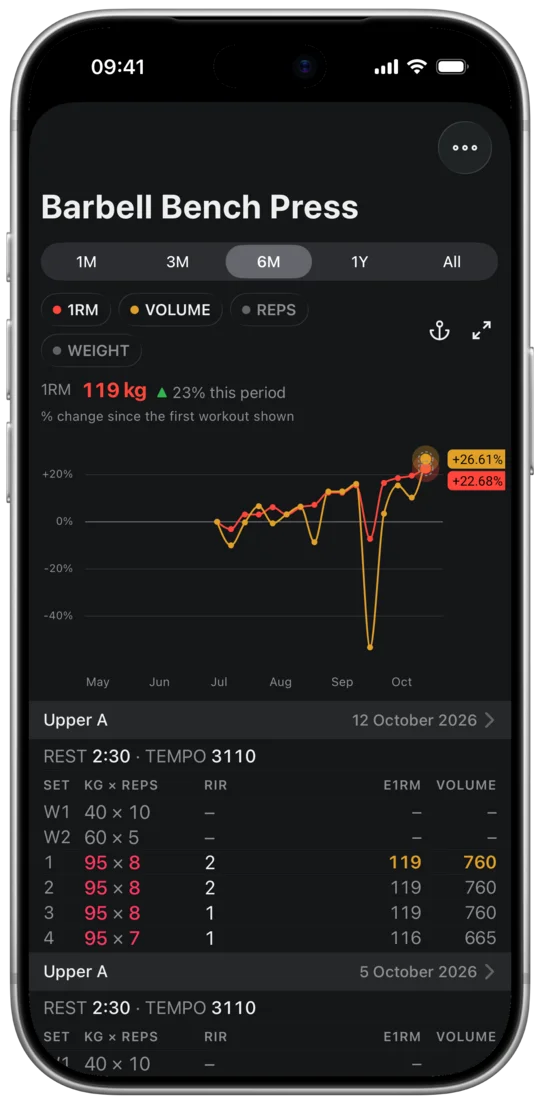
The SmartWorkout app doesn't count calories or your weekly average weight: the calorie calculator gives you your starting calories, the rules above give you the adjustments, and the “Weight” screen shows all your weigh-ins on a chart. Whether your strength is holding on the cut you can check on the exercise chart: if your estimated 1RM on the main lifts stays flat through the whole cut, the deficit isn't costing you strength.
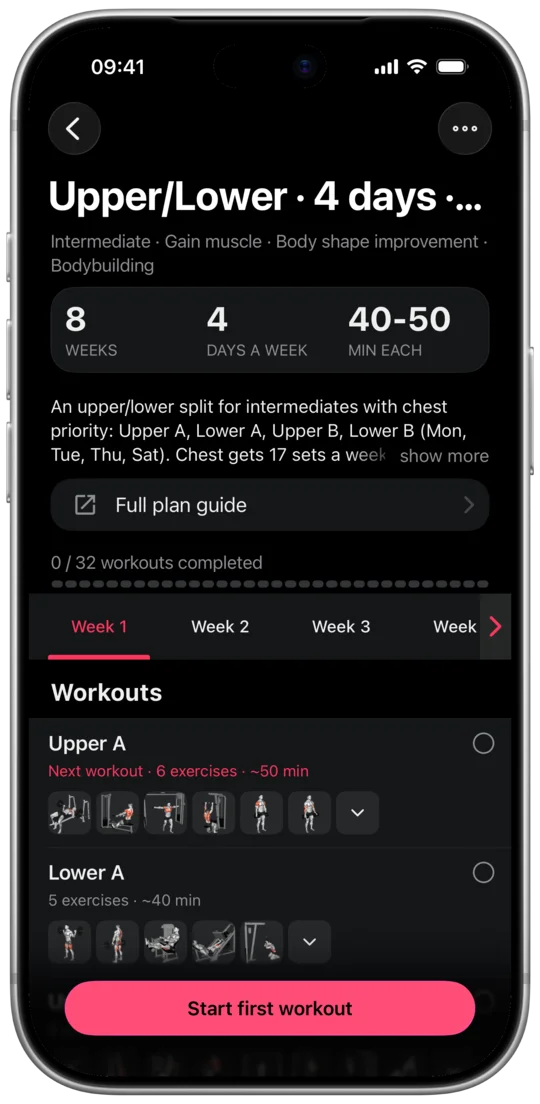
How to lay out a block and what to do after it is covered on the mesocycle page, and editing a plan by hand in the plan creator article. You'll find a ready-made 4-day block in the 4-day upper-lower plan; you can count weekly sets per muscle group in the volume calculator and your starting calories in the calorie calculator.
Log it in SmartWorkout
A free workout log for iPhone and Android: sets, RIR, tempo, exercise groups and plans.


Questions
Should I change my workout plan on a cut?
You don't have to. Changing exercises at the start of a cut takes away your reference point: you can't tell whether a weaker result comes from the deficit or the new exercise. Build a new plan after the cut, based on its results.
How much weight should I lose per week on a cut?
Usually 0.5% of body weight per week: 0.4 kg at 80 kg, 0.5 kg at 100 kg. Go toward 1% per week only if you carry a lot of fat, and even then with a deficit no bigger than 30% of maintenance. Watch the average of 7 morning weigh-ins, because a single weigh-in swings with water and food.
Should I deload on a cut?
Yes, just as on a bulk, at the end of a block. If signs of fatigue show up, deload earlier.
Can you build muscle on a cut?
In a study on elite athletes, the group losing weight more slowly gained a little lean mass, but that is one small study. A meta-analysis shows muscle grows less in a deficit than without one.
How is a cut different from body recomposition?
Recomposition is gaining muscle and losing fat at the same time. It doesn't need a separate plan: if your weights and reps go up on a cut, that's what you're doing.
See also
- Training on a bulk: how to build muscle and strength without extra fatA bulk is strength training in a small calorie surplus, aimed at hypertrophy (muscle growth) and getting stronger. Body weight should rise by about 0.25-0.5% per week. Faster gain adds mostly fat.
- How to make a workout plan for the gym: exercises, sets, order and session lengthA workout plan (or workout program) is a written training week: days, exercises, sets, reps, reps in reserve (RIR) and rest. To make one, start with the number of days, then pick exercises and count weekly sets per muscle group. The 2026 ACSM position stand advises at least 2 sets per exercise and 2-3 reps in reserve.
- Training volume: what it is and what MEV, MAV and MRV meanIn hypertrophy training, training volume is the number of working sets a muscle group gets per week. In a meta-analysis of 67 studies, growth was measurable from about 4 weekly sets, with each extra set adding less; the 2026 ACSM position stand links 10 or more weekly sets to more growth.
- How to prioritize lagging muscle groups: which 1-2 to pick and how many setsMuscle priority (prioritizing a lagging muscle group) is a plan in which 1-2 muscle groups get 4-8 more weekly sets than in a balanced plan, usually 12-18, while the rest stay at 4-10. In a meta-analysis of 67 studies, muscle growth rose with weekly sets, though each extra set added less.
- Rep ranges: how many reps for hypertrophy, strength and cuttingA rep range is the span of reps, such as 8-12, in which a set with a given weight should end. For muscle growth the exact number matters little: in studies, muscle grew similarly with sets of about 5 to more than 30 reps close to failure, while strength grew most with loads of 80% of 1RM or more.
- Training to failure: when it helps and when it just adds fatigueTraining to failure means ending a set only when, despite full effort, you cannot complete the next rep through a full range of motion without changing your form. In a meta-analysis of 15 studies it built no significantly more muscle or strength than stopping short of failure, and it is clearly more fatiguing.
- Deload week: when to deload, how long it lasts and how much to cutA deload (deload week) is a planned week of lighter training that clears fatigue before the next block. Every deload cuts the number of sets, usually by 30-50%, and often ends sets further from failure. The weight stays the same or drops by about 10%, especially when your joints hurt.
- Mesocycle training: how long a training block lasts and how to plan oneA mesocycle (training block) is a block of several weeks, usually 4-8, built around one goal and often ending with a lighter week (deload). It is made of microcycles, usually one training week each, and several mesocycles form a macrocycle, usually a year.
Sources
- Murphy C, Koehler K. Energy deficiency impairs resistance training gains in lean mass but not strength: A meta-analysis and meta-regression. Scand J Med Sci Sports. 2022;32(1):125-137 (online 2021).
- Helms ER, Aragon AA, Fitschen PJ. Evidence-based recommendations for natural bodybuilding contest preparation: nutrition and supplementation. J Int Soc Sports Nutr. 2014;11:20.
- Garthe I, Raastad T, Refsnes PE, et al. Effect of two different weight-loss rates on body composition and strength and power-related performance in elite athletes. Int J Sport Nutr Exerc Metab. 2011;21(2):97-104.
- Helms ER, Fitschen PJ, Aragon AA, et al. Recommendations for natural bodybuilding contest preparation: resistance and cardiovascular training. J Sports Med Phys Fitness. 2015;55(3):164-78 (online 2014).
- Barakat C, Pearson J, Escalante G, Campbell B, De Souza EO. Body Recomposition: Can Trained Individuals Build Muscle and Lose Fat at the Same Time? Strength Cond J. 2020;42(5):7-21.
- Mifflin MD, St Jeor ST, Hill LA, Scott BJ, Daugherty SA, Koh YO. A new predictive equation for resting energy expenditure in healthy individuals. Am J Clin Nutr. 1990;51(2):241-7.
- Frankenfield D, Roth-Yousey L, Compher C. Comparison of predictive equations for resting metabolic rate in healthy nonobese and obese adults: a systematic review. J Am Diet Assoc. 2005;105(5):775-89.
- Racette SB, Weiss EP, Schechtman KB, et al. Influence of weekend lifestyle patterns on body weight. Obesity (Silver Spring). 2008;16(8):1826-30.
- Forbes GB. Body fat content influences the body composition response to nutrition and exercise. Ann N Y Acad Sci. 2000;904:359-65.
- Jensen MD, Ryan DH, Apovian CM, et al. 2013 AHA/ACC/TOS guideline for the management of overweight and obesity in adults. Circulation. 2014;129(25 Suppl 2):S102-38.
- Vargas-Molina S, Bonilla DA, Petro JL, et al. Efficacy of progressive versus severe energy restriction on body composition and strength in concurrent trained women. Eur J Appl Physiol. 2023;123(6):1311-1321.
- Hall KD, Chow CC. Estimating changes in free-living energy intake and its confidence interval. Am J Clin Nutr. 2011;94(1):66-74.
- Hall KD. What is the required energy deficit per unit weight loss? Int J Obes (Lond). 2008;32(3):573-6.
- Thomas DM, Martin CK, Redman LM, et al. Effect of dietary adherence on the body weight plateau: a mathematical model incorporating intermittent compliance with energy intake prescription. Am J Clin Nutr. 2014;100(3):787-95.
- Kosar SN, Guzel Y, Kose MG, Kin Isler A, Hazir T. Whole and segmental body composition changes during mid-follicular and mid-luteal phases of the menstrual cycle in recreationally active young women. Ann Hum Biol. 2022;49(2):124-132.
- Trexler ET, Smith-Ryan AE, Norton LE. Metabolic adaptation to weight loss: implications for the athlete. J Int Soc Sports Nutr. 2014;11(1):7.